
Buying a commercial induction cooker is rarely a simple wattage decision. A restaurant, hotel kitchen, caterer, or foodservice equipment distributor must match the unit to the cooking workflow, installation format, electrical supply, controls, and expected operating load. Our buying process starts with the actual job the equipment must perform, then works backward to the configuration that fits it.
1. Define the Cooking Task First
Start with the food and cooking method rather than the product label. High-volume boiling, wok frying, batch cooking, simmering, buffet holding, and general line cooking can require different equipment formats.
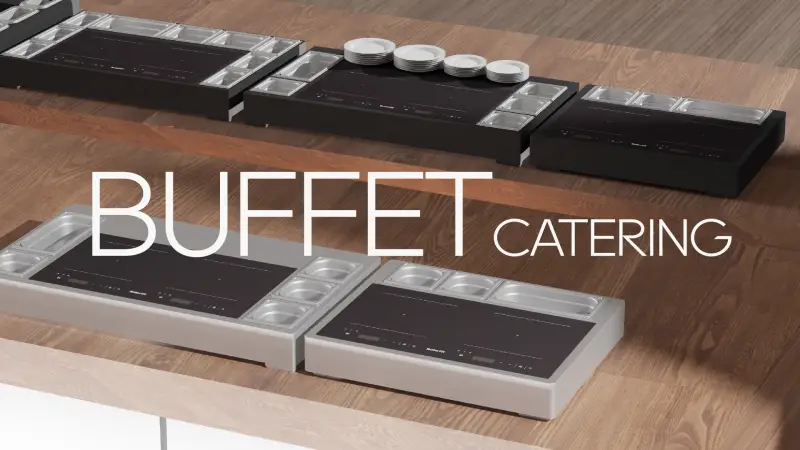
The commercial range on our site spans table-top, free-standing, built-in, drop-in, heavy-duty, fryer, warmer, wok, buffet station, and cooking-island configurations. That range matters because physical form should follow workflow.
2. Match Power to Workload
Wattage is useful only when interpreted against the cooking task and available supply. Our commercial portfolio includes 3500W units designed for high-volume cooking, while specific heavy-duty configurations reach 5000W per cooking position. One listed free-standing model, for example, uses 380–420V three-phase input and 5000W × 2.
A buyer should therefore confirm both required output and the site's electrical capacity before selecting a model. The same principle applies when comparing commercial induction cooking equipment from different suppliers.
3. Check the Electrical Specification
Voltage, phase, frequency, and plug or hard-wiring requirements can determine whether a unit is practical at the installation site. Do not compare two machines on wattage alone if their electrical inputs differ.
Request the exact electrical specification for the selected configuration and have the installer verify compatibility before the purchase order is finalized. For international projects, the electrical requirement should be treated as part of the initial equipment specification, not an installation detail left until delivery.
4. Choose the Installation Format Around the Kitchen Layout
A table-top cooker can suit flexible workstations, while free-standing equipment creates a more dedicated cooking position. Built-in or hidden and drop-in designs can be incorporated into counters or purpose-built stations. Cooking islands can combine several functions into one integrated layout.
Better Induction presents these formats as distinct commercial categories, so we would select the enclosure and installation style only after reviewing the kitchen plan. Space, access, operator position, and surrounding equipment should all be considered together.
5. Examine the Control Method
Control design affects how operators interact with the equipment during service. Available configurations include smart touch and knob-controlled products. A table-top model listed by us combines touch control with a safety lock, while another free-standing model uses knob control.
The right choice depends on the operating environment, staff workflow, cleaning routine, and the level of control required by the buyer. A technically capable cooker can still be a poor fit if its interface does not suit daily operation.
6. Look at the Temperature and Power Range
A useful specification sheet should show more than maximum wattage. Temperature range, selectable power levels, and timer functions reveal whether the cooker can handle the intended sequence of tasks.
For example, one 3500W table-top model offers 1–10 power levels, 1–10 temperature settings, and a 60–240°C temperature range. Those details are more useful for procurement than a headline power figure by itself.
7. Consider Thermal Protection and Construction
Commercial equipment faces repeated heating cycles, spills, and intensive handling. Construction and protection features therefore deserve a place in the evaluation.
Our products include stainless-steel bodies, electronic overheating protection, and, on one table-top model, a Schott Ceran or EuroKera glass hob option. Heavy-duty equipment on the commercial page is also described with reinforced coils, impact-resistant surfaces, and thermal-management provisions.
8. Check Whether the Configuration Fits the Cookware and Station
Induction equipment must work with the cookware and station design used in the operation. The question is not simply whether a pan can heat; the cooking position, vessel size, clearance, control location, and surrounding counter space must work together.
Wok cooking may call for a dedicated induction-wok configuration, while buffet service may call for a warmer or buffet station instead of a high-output cooking hob. The equipment category should therefore reflect the actual station rather than a generic specification.
9. Review Operating Functions Against the Workflow
Automation can matter more than additional peak power in specific processes. Our automatic induction cooking category is intended for programmable time-temperature control and applications such as batch cooking, simmering, and sauce preparation.
If a process requires unattended or repeatable stages, ask whether the selected model provides the necessary controls rather than paying for capacity the workflow cannot use. This distinction can be particularly important when commercial induction cooking equipment is being specified for standardized production.
10. Evaluate the Supplier's Product Depth
The final factor is the supplier's ability to support the exact configuration rather than simply provide one cooker. A commercial buyer may need different formats across a project, from single-hob equipment to induction fryers, warmers, wok systems, or cooking islands.
Better Induction offers a broad commercial portfolio and invites buyers to contact its team for product information, quotations, and production-base, showroom, or R&D-center visits. For larger commercial induction cooking equipment projects, that broader product coverage can simplify specification and supplier coordination.
How to Evaluate a Commercial Induction Cooker for Your Kitchen
The strongest purchasing decision connects ten factors into one practical specification: cooking task, power, electrical input, installation format, controls, temperature range, protection, cookware fit, workflow functions, and supplier capability.
By outlining your needs before asking for quotes, you give suppliers a uniform brief to bid against. This makes it much easier to spot true differences between models and prevents you from choosing a machine driven by just one flashy metric.
A commercial induction cooker should ultimately be selected because it fits the kitchen's real work, not because its headline specification looks impressive. Reviewing the configuration in this order reduces mismatches between equipment and site requirements and makes supplier discussions more precise. For projects that require multiple commercial formats or customized solutions, a manufacturer with a broad product range can make that evaluation considerably easier.
GET IN TOUCH
Contact With us