
Restaurant buyers evaluating a 3500W induction cooker are not simply choosing a cooker with a higher wattage number. The real purchasing decision is whether a 3500W commercial unit matches the kitchen's electrical supply, cooking requirements, available counter space, and operating workflow.
That makes the buying process different from selecting an induction cooker for home use. We need to look at the exact commercial specification and determine whether the particular configuration is appropriate for the foodservice station where it will operate. The Better Induction 3500W commercial range provides several models that can be compared at this level.
Is 3500W the Right Power Class for Your Restaurant Station?
The first question for a restaurant buyer is not which model looks best, but whether 3500W corresponds to the intended cooking requirement. The answer depends on what the equipment is expected to do within the foodservice operation.
A 3500W rating represents the maximum rated heating power of the relevant configuration. However, commercial models can provide multiple operating levels rather than running only at their maximum output. E350S, for example, specifies 10 power levels from 350W through 3500W.
That range is relevant during procurement because restaurant cooking does not necessarily require maximum output for every task. A buyer should therefore evaluate the complete power adjustment range rather than treating “3500W” as the only performance specification.
We would also distinguish between the restaurant's required cooking task and the equipment's physical format. The 3500W commercial category includes different countertop and other configurations, so the correct choice starts with the station requirement rather than the wattage label alone.
Which 3500W Electrical Configuration Should You Order?
Electrical compatibility needs to be confirmed before the purchase order is issued. Voltage, frequency, plug configuration, and rated power should be matched to the destination market and the installation environment.
E350S is specified at 220–240V, 50–60Hz, and 3500W. Its product information separately identifies a 3000W version for the UK plug configuration. A restaurant-equipment buyer therefore should not assume that every regional version will have an identical electrical specification.
That distinction becomes especially important for importers and distributors handling multiple markets. The product name may identify the 3500W category, while the actual order still needs an agreed electrical configuration.
Our purchasing specification would record the destination market first, followed by voltage, frequency, rated power, and plug requirement. Confirming those details before production or shipment reduces the risk of selecting a configuration that does not correspond to the intended installation.
What Controls Should a Restaurant Buyer Expect at 3500W?
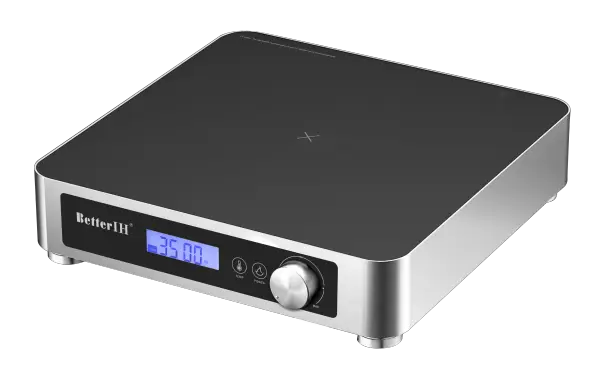
Restaurant buyers should also examine how the operator controls the available heating power. E350S provides 10 power levels from 350W to 3500W and a temperature setting range of 60°C to 240°C. The same specification lists a 0–180 minute timer.
Those numbers are more useful for purchasing than a general statement that the cooker has “adjustable power.” They tell the buyer how finely the operator can change the selected setting and what temperature range the model specifies.
Interface design is another model-level difference. E350S is documented with touch control, an LCD display, and knob adjustment for power or temperature. A restaurant purchasing team should compare that arrangement with the way operators will actually use the cooker during service.
The objective is not to select the most complicated interface. Instead, the buyer should specify the controls that correspond to the cooking station and ensure those controls are included in the exact model being quoted.
Will the Cooker Fit the Countertop and Cooking Station?
A restaurant cannot evaluate a commercial induction cooker independently from its workstation. Countertop dimensions, surrounding equipment, and operator access all affect whether a particular model is practical for the intended location.
E350S is listed at approximately 39.6 × 41.5 × 9.4 cm. That gives a buyer a measurable footprint to compare against the available preparation or cooking surface rather than relying on a general description such as “compact countertop design.”
Construction should be included in the same physical assessment. The E350S specification identifies a stainless-steel body and glass hob options including Schott Ceran and EuroKera France. These are specific product details that can be recorded in an equipment specification when comparing configurations.
For a 3500W induction cooker, the procurement decision therefore involves both the cooking specification and the physical specification. A model that satisfies the electrical requirement still needs to fit the actual station.
What Should Be on Your 3500W Induction Cooker Purchase Specification?
Before requesting a quotation or placing an order, we recommend turning the restaurant's requirements into a model-specific checklist. The first group should cover electrical input: destination market, voltage, frequency, rated wattage, and plug configuration.
The second group should document operating controls, including available power levels, temperature range, timer range, and interface type. The third should cover physical details such as dimensions, body material, and hob configuration.
Finally, the buyer should compare the exact commercial model against the intended foodservice station. The Better Induction range includes multiple commercial induction configurations, so selecting a product by wattage alone does not provide enough information for a proper procurement decision.
A 3500W specification can be appropriate for a restaurant station, but the wattage should be treated as the starting point of the buying process, not the final selection criterion. We use the complete model specification to determine whether the electrical configuration, adjustable operating range, controls, dimensions, and construction correspond to the buyer's requirements.
This workflow-first approach takes the guesswork out of buying for operators, distributors, and equipment purchasers alike. Instead of assuming all 3500W units are built the same, Better Induction helps you dial in the exact setup you need. In the end, your purchase order should clearly spell out both the model and its configuration, giving everyone involved a foolproof blueprint for the build.
GET IN TOUCH
Contact With us