
A restaurant does not buy an induction cooker simply because the specification says 3500W. During service, the equipment has to respond to real cooking demands: stronger heating when required, quick adjustment when the dish changes, and controls that staff can operate without interrupting their workflow.
That makes the specification sheet worth reading differently. Rather than asking how many features a commercial induction cooker has, we would ask which specifications actually affect the way a restaurant uses the equipment. For a 3500W model, several details deserve attention before the equipment is selected for a cooking station.
Will the Cooker Actually Use Its 3500W Capacity?
Maximum wattage matters most when the cooking station needs substantial heating output. A restaurant preparing demanding dishes or working through repeated cooking cycles may benefit from having more power available at the upper end.
The number “3500W,” however, does not mean that every cooking task should run at maximum output. A useful commercial cooker should provide enough adjustment below the maximum so operators can match the heat to the food being prepared.
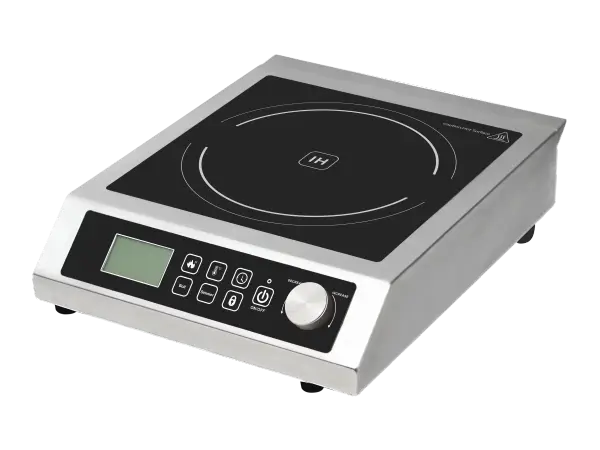
The HBE350C provides an example. Its published specification lists 10 power levels from 350W to 3500W, together with 10 temperature settings from 60°C to 240°C.
That lower end is significant. A restaurant may need the same station to perform high-output heating at one moment and much gentler heating later. We therefore consider the usable range more informative than the maximum number by itself.
Can Staff Change the Heat Without Slowing Down?
Restaurant cooking rarely follows one fixed heat setting. Operators may need to increase output, reduce it, or maintain a particular cooking condition as the dish progresses.
Control design consequently becomes part of the equipment's usability. The 3500W commercial range includes several models under the “Sleek Knob” category, providing a physical control option for commercial operators who prefer direct adjustment.
The right interface depends on the station. A cooker positioned where staff make frequent manual adjustments should have controls that suit that working pattern. A model selected for a built-in installation may have different priorities from a portable table-top unit.
Timer operation can also influence the workflow. HBE350C, for example, is specified with an LED-display timer adjustable from 0 to 180 minutes.
Rather than treating the timer as an extra feature for a specification sheet, we would ask whether timed cooking is genuinely useful for the dishes and processes handled at that station.
What Happens When the Cooker Gets Heavy Use?
Commercial equipment has a different operating environment from a domestic appliance. Staff may use the cooker repeatedly throughout a service period, so the physical construction becomes part of the product specification.
HBE350C is listed with a stainless-steel body and glass hob options including Schott Ceran and EuroKera France configurations.
The relevant point for a restaurant buyer is not simply the material name. The buyer should identify the exact surface and body configuration supplied with the selected model and determine whether it fits the intended station.
We also distinguish between a portable cooking position and a purpose-designed commercial installation. The Better Induction 3500W range includes table-top, free-standing, built-in/hidden, drop-in, and heavy-duty categories.
A 3500W rating therefore does not define the complete physical product. The equipment format still needs to correspond with where and how the restaurant intends to operate it.
Which Protective Functions Should Be on the Specification Sheet?
Safety features should be checked at model level rather than assumed from the 3500W rating.
HBE350C, for example, lists electronic overheating protection and a safety lock as part of its published specifications.
Those functions address different operating situations. Overheating protection relates to the equipment's protective system, while a safety lock concerns operation of the controls. For a restaurant, both should be understood in the context of how staff will use the cooker.
We would also avoid assuming that every model in a product family has precisely the same configuration. The commercial range contains multiple models and designs, so the specification for the actual model being ordered should be checked before procurement.
This is particularly important for restaurant groups and distributors specifying several units. A general category description is not a substitute for the technical details of the individual cooker.
Does the 3500W Model Fit the Cooking Station?
A cooker can meet the required power specification and still be inconvenient if its physical dimensions do not suit the counter.
HBE350C is published at approximately 31 × 43 × 9.3 cm. Before installation, the buyer should compare the selected model's dimensions with the available workspace and the position of surrounding equipment.
Positioning affects more than whether the appliance physically fits. Staff need practical access to the controls and cooking surface, while the surrounding station needs to accommodate the cookware and other equipment used during preparation.
Our 3500W commercial portfolio therefore covers more than one physical arrangement. The appropriate configuration depends on whether the restaurant needs a table-top unit, a built-in solution, or another commercial format listed in the range.
Which Specifications Should a Restaurant Put First?
A restaurant evaluating a 3500W induction cooker should first establish whether the available power range matches its actual cooking work. A maximum of 3500W is useful only when the station benefits from that additional capacity, while lower settings remain important for less demanding cooking stages.
Control comes next because the operator has to translate that available power into practical cooking adjustments. The control interface, temperature settings, and timer should be considered according to the way the station is operated rather than as isolated feature counts.
Construction and protective functions then help define the actual equipment configuration. Stainless-steel body options, specified hob materials, overheating protection, and safety-lock functions are all details that should be verified against the selected model.
We look at a 3500W induction cooker as a complete system, not just a power rating. Since commercial kitchens require different physical formats and layouts, focusing solely on wattage misses the point. You need to know if the entire configuration matches how your station actually operates.
This approach gives buyers a streamlined framework for decision-making. Start with your actual cooking volume, verify the usable power, check the control interface, confirm the casing and protection specs, and tie it all to your installation space. Ultimately, investing in a3500W induction cooker pays off only when every element supports your team's real-world routine.
GET IN TOUCH
Contact With us