
Choosing between a commercial induction cooktop and a gas burner is rarely a simple technology comparison. Restaurant buyers have to consider what the cooking station actually does, how much controllable heat it needs, what cookware the kitchen uses, and whether the building already supports gas or high-power electrical equipment.
A 3500W induction cooker deserves attention when a restaurant wants substantial heating output in a commercial countertop format. Gas, however, can remain the better choice for stations built around open-flame cooking. We believe the right comparison starts with the kitchen scenario rather than the equipment label.
A Busy Sauté Station Changes the Wattage Question
Picture a restaurant where one cooking station regularly moves between bringing cookware up to temperature, sautéing ingredients, and reducing sauces. Maximum output matters here, but the ability to move between different heat levels matters just as much.
Our 3500W commercial range includes models with adjustable power rather than offering only a single maximum setting. HBE350C, for example, specifies 1–10 power levels from 350W to 3500W, together with 1–10 temperature settings from 60°C to 240°C.
Gas provides a different type of control through the flame. A chef can see the flame immediately and adjust it directly, which remains useful for traditional cooking techniques and recipes where flame behavior is part of the process.
The buyer therefore needs to ask what “control” means for the station. If the priority is adjustable electrical heating across a defined range, 3500W induction becomes a relevant option. If the cooking method depends on visible flame, gas may still have the stronger case.
If the Menu Depends on an Open Flame, Gas Has a Clear Role
Not every restaurant should replace gas with induction simply because induction is modern or electrically powered. Some cooking stations are designed around flame itself.
Gas is particularly familiar in kitchens using traditional sautéing, flame-based techniques, or cookware that does not have an induction-compatible magnetic base. That flexibility can simplify operations when a restaurant already has a broad collection of conventional cookware.
Wok cooking also requires careful consideration. A standard flat induction cooktop should not automatically be treated as equivalent to a dedicated gas wok burner. Buyers should match the equipment geometry and heating method with the actual cookware and technique used at the station.
That makes gas the logical choice in certain kitchen environments. The question is not whether induction can generate strong heat; it is whether the cooking method benefits from the way induction generates and controls that heat.
When the Line Needs Less Surrounding Heat, the Comparison Shifts
Kitchen environment can change the purchasing decision. Gas combustion introduces an open flame and releases heat into the surrounding workspace, while induction transfers energy into compatible cookware through an electromagnetic field.
For a restaurant operating in a compact cooking line, the surrounding working environment can therefore become part of the equipment discussion. Operators may value a cooking surface that is easier to wipe down and does not require the same burner-grate arrangement found on conventional gas equipment.
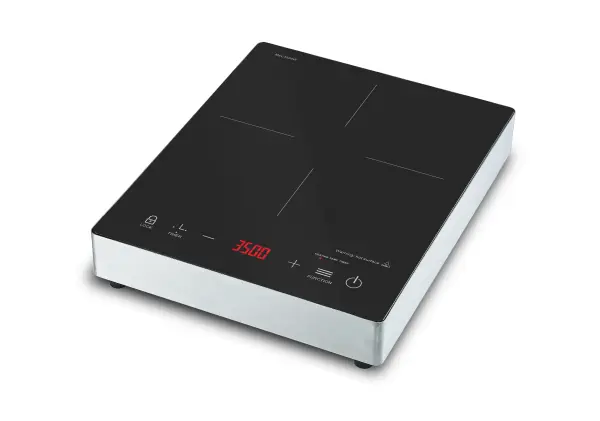
Our E350S, for instance, uses a stainless-steel body with a glass hob and specifies touch control with knob adjustment for power or temperature. Its documented power range is 350W–3500W, with a temperature range of 60°C–240°C.
Those characteristics do not automatically make induction superior. They simply make it particularly worth considering for restaurants where controllable heat and the physical design of the cooking station are important purchasing criteria.
Existing Gas Lines Can Make the Answer Surprisingly Simple
A restaurant starting from an empty site has more freedom than one replacing equipment in an established kitchen. Existing infrastructure can heavily influence the final decision.
A gas-equipped kitchen may already have the gas supply, ventilation arrangement, and cooking-line layout designed around burners. Replacing that setup with electrical cooking equipment can require a different infrastructure assessment.
An induction installation has its own requirement: the electrical supply must match the selected model. HBE350C is specified at 220–240V, 50–60Hz and 3500W, with a 3000W version identified for the UK plug. E350S carries the same stated voltage and frequency range and also identifies a 3000W UK-plug version.
For international buyers, that detail matters. A restaurant should confirm the destination market, available electrical supply, and exact product configuration before treating 3500W as a straightforward replacement for a gas burner.
One Cooking Station May Tell You More Than the Whole Kitchen
The strongest buying decision often comes from examining the individual station rather than trying to choose one cooking technology for the entire restaurant.
Consider a hotel breakfast counter, a compact café kitchen, a catering workstation, or a restaurant prep station. Each may need a different combination of heat output, temperature adjustment, countertop space, cookware compatibility, and infrastructure.
A 3500W induction cooker becomes particularly relevant when the station needs substantial adjustable output and the kitchen can provide the required electrical configuration. Gas remains attractive where open flame, conventional cookware, or an established gas cookline is central to the operation.
Better Induction's 3500W commercial range includes multiple configurations rather than one universal model, including E350S, BE350A, HB350A, HB350A-1, HB350K5, HBE350C, HBE350K, HBE350F, HBE350I, and BT-350H-1.
That variety reinforces an important point for buyers: “3500W” identifies a power class, not a complete equipment specification. The actual model still needs to fit the station's dimensions, controls, cookware, electrical requirements, and cooking workflow.
The Better Choice Is the One Your Cooks Can Actually Use
A technology comparison becomes useful only when it ends with a practical decision. Induction is worth prioritizing when a restaurant needs controlled electrical heating, substantial output, a suitable countertop configuration, and an installation environment that can support the selected model.
Gas deserves priority when the kitchen depends on open-flame techniques, has strong existing gas infrastructure, or needs the broad cookware flexibility associated with conventional burners.
Picking equipment based purely on peak wattage is a trap. Across Better Induction's commercial lineup, you quickly see why power output, control styles, physical footprints, and electrical setups all have to be evaluated as a package.
At the end of the day, the decision comes down to the individual station. If a spot calls for flexible high-heat cooking and your kitchen is wired for it, a 3500W induction cooker is tough to beat. But if a station's entire workflow relies on seeing an open flame, gas might still be the smarter choice.
For anyone buying commercial gear, the takeaway is simple: stop asking which technology is universally superior. Instead, ask which option actually handles the daily grind of that specific station.
GET IN TOUCH
Contact With us