
A 1500W difference sounds significant, but wattage alone does not tell a buyer whether a cooker is actually the better choice. The more useful question is what happens during a normal cooking cycle: how much heating capacity is needed, how often high output is required, and whether the cooker must handle different cooking tasks from the same station.
That distinction matters particularly in commercial equipment purchasing. A 2000W model may be adequate for one operation but restrictive for another. A 3500W model may provide valuable extra capacity in a demanding station, yet its higher rating is not automatically necessary for every application. We would make the decision by looking at the workload the equipment is expected to carry.
3500W and 2000W Do Not Represent the Same Heating Ceiling
The clearest difference is the maximum electrical power available to the induction heating system. A 3500W induction cooker has a higher maximum rating than a 2000W cooker, giving the operator more available power when the cooking task calls for it.
That difference becomes relevant when a station regularly operates under heavier heating demand. If the equipment spends a substantial part of its working time close to its upper output, the extra capacity can become a practical part of the cooking setup rather than just a specification-sheet number.
A 2000W unit, on the other hand, may be sufficient where the cooking workload is lighter. Smaller quantities, less demanding heating cycles, or a supplementary cooking position may not justify specifying the higher power level.
For that reason, comparing the two ratings should begin with the cooking station itself. The question is not whether 3500W is technically more powerful. It is whether the additional capacity will be used.
When Does a 2000W Cooker Make More Sense?
A lower-rated cooker can be the rational choice when maximum heating output is not central to the operation.
Consider a station that handles limited cooking quantities and does not repeatedly move between demanding heating cycles. If its normal workload can be completed without requiring a higher power ceiling, 2000W may provide a more appropriate specification.
The same principle applies when the induction unit is not the primary cooking station. A secondary cooker used for occasional preparation has a different job from equipment expected to support continuous commercial production.
Electrical planning should also enter the decision before equipment is ordered. The power rating needs to correspond with the electrical configuration available at the installation location. A buyer should establish the electrical requirements based on the cooking workload. The equipment and installation can then be matched to those requirements.
For OEM and ODM projects, this distinction is especially useful. We can start from the customer's intended application and determine whether the requested power level is actually justified by the operating scenario.
When Is 3500W Worth Specifying?
The case for higher power becomes stronger when the cooker must provide greater heating capacity on demand.
A 3500W induction cooker gives a commercial cooking station a substantially higher maximum output than a 2000W unit. That additional headroom can be relevant where the operator needs stronger heating performance as part of the normal workflow rather than only for occasional use.
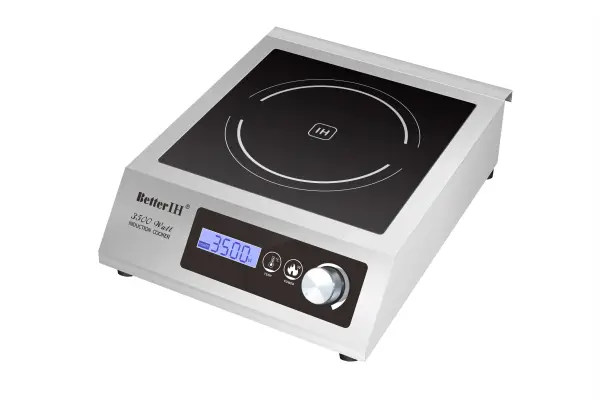
Our referenced commercial range is specifically organized around 3500W induction equipment, with multiple product configurations under the “Sleek Knob” and “Metal Design” categories. The same page also organizes the wider commercial portfolio by formats such as table-top, free-standing, built-in/hidden, drop-in, and heavy-duty equipment.
This is important because power selection does not happen independently from product format. A buyer specifying equipment for a particular commercial installation may need to consider how the cooker will be positioned and operated as well as how much power it requires.
Higher wattage therefore makes the most sense when the cooking station has a genuine reason to use that additional capacity. If the extra output has no meaningful role in the daily cooking process, the specification becomes harder to justify.
The Real Comparison Is Maximum Power vs. Actual Workload
The easiest mistake is to compare 3500W and 2000W as though the higher number automatically represents the better purchase.
Imagine two kitchens with completely different operating rhythms. The first uses an induction cooker for modest preparation and occasional heating. The second depends on the same type of equipment for more demanding cooking work throughout service. Giving both kitchens the same power specification ignores the reason the equipment is being purchased.
A useful procurement exercise is to record the tasks performed at the station and identify which ones genuinely require higher heating capacity. Pay particular attention to periods when several cooking tasks occur consecutively. Those peak periods reveal more about the required specification than an average day.
We also look at the control method rather than treating maximum wattage as the entire product. The referenced 3500W range includes multiple knob-controlled models, including E350S, BE350A, HB350A, HB350A-1, and HB350K5, alongside metal-design models such as HBE350C, HBE350K, HBE350F, HBE350I, and BT-350H-1.
For a commercial buyer, that means the comparison should be between a complete equipment configuration and the intended cooking job, not between two wattage figures in isolation.
So, Which Power Level Should You Choose?
Go with 2000W if your station has a relatively light day-to-day workload and you rarely find yourself needing extra heat. Buying a higher-rated cooker in this scenario usually means paying for power you’ll rarely tap into.
Step up to 3500W if your kitchen operations genuinely require that extra muscle. That higher ceiling is a game-changer for heavy-duty cooking tasks and gives you the headroom necessary to breeze through rush hours.
Before finalizing any commercial purchase, make sure to evaluate your actual workflow and electrical setup. Keep in mind that 3500W units come in various commercial configurations—not just a one-size-fits-all build, as noted on the Better Induction reference page.
The practical difference between the two power levels is therefore straightforward: 2000W suits a workload that does not routinely demand more, while 3500W is the stronger specification when additional heating capacity has a clear operational purpose.
We don't believe in one-size-fits-all power specs. At Better Induction, we look at your actual cooking workflow first, then build the setup around it. If you're still weighing your options, ditch the question of "Which cooker is stronger?" and ask instead: "What's the hardest job this station will face on a busy day?"
GET IN TOUCH
Contact With us