
For a restaurant, the choice between induction and gas comes down to more than cooking preference. The decision affects how heat is delivered, how cooks adjust it, how equipment fits the kitchen, and how each station handles its daily workload.
Neither technology is automatically the right answer for every restaurant. We compare them by looking at what happens during actual cooking and what the kitchen needs from its equipment. That makes it easier to see where a commercial induction cooker has an advantage and where gas remains a sensible option.
Two Different Ways to Put Heat Into the Pan
Gas produces heat through combustion and transfers that heat from the flame to the cookware. Induction takes a different route: an electromagnetic field heats compatible cookware directly.
That distinction is central to the comparison. The U.S. Department of Energy explains that induction heats cookware directly and reports that it can provide faster boiling and precise, even heating compared with traditional cooking technologies.
Gas gives cooks a familiar visual reference because the flame is immediately visible. Induction instead relies on electronic power or temperature controls. For a kitchen that frequently changes cooking levels, the preferred system may depend on how operators are accustomed to working.
Our commercial range includes smart-touch and automatic equipment, with automatic models offering programmable time-temperature control for applications such as batch cooking, simmering, and sauce preparation.
Where Induction Has the Edge—and Where Gas Still Fits
Induction becomes particularly interesting when a restaurant values controlled heat delivery and repeatable operation. Electronic controls can provide a different way of managing cooking compared with manually adjusting a gas flame.
Gas, however, should not be dismissed simply because induction offers precise electronic control. Restaurants built around flame-based techniques may have cooks, recipes, and workflows that are already optimized for gas. Changing the heating technology can therefore involve operational adjustments beyond replacing the equipment.
Energy transfer is another point where the technologies differ. Commercial testing summarized by the U.S. Department of Energy's Better Buildings initiative reported water-boil efficiency of approximately 80–85% for induction compared with 25–40% for natural-gas open burners in the cited testing.
Those figures demonstrate a meaningful difference in tested heat-transfer efficiency, but they should not be treated as a guaranteed restaurant cost saving. Actual operating economics depend on cooking volume, service hours, utility prices, cookware, and other kitchen conditions.
A Busy Service Changes the Comparison
The comparison becomes more practical when equipment is placed in a busy restaurant station. Continuous boiling, wok cooking, frying, and batch preparation can place very different demands on a cooking unit than occasional preparation.
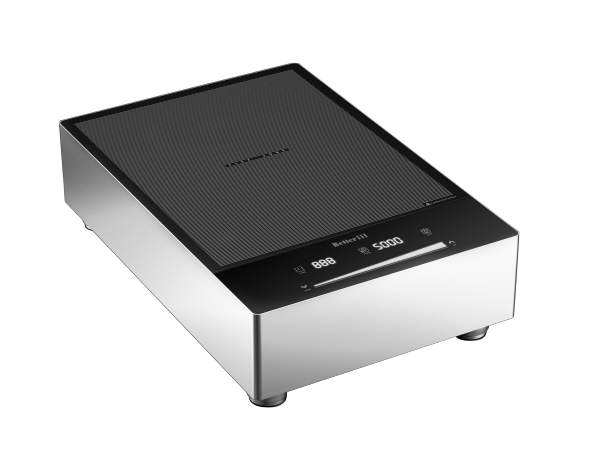
Commercial induction cooking equipment therefore needs to be selected according to workload. Our commercial range includes 3500W models for high-volume cooking and separate heavy-duty configurations for demanding commercial applications.
Gas can also provide substantial cooking capacity, particularly in kitchens already designed around gas infrastructure. For either technology, however, a higher nominal input does not automatically mean better results for every application.
The better comparison considers what the station actually does throughout service. A restaurant should look at cooking frequency, vessel size, expected production volume, operating hours, and whether the same station switches repeatedly between different cooking tasks.
The Kitchen Setup Can Decide the Winner
A restaurant may have an excellent reason to choose one technology before cooking performance is even compared: the kitchen infrastructure.
Gas equipment requires an appropriate gas supply and installation arrangement, while induction equipment depends on sufficient electrical capacity. Before comparing either technology, restaurant operators should therefore confirm that the available utilities can support the selected cooking equipment.
The kitchen layout then becomes the next point of comparison. Gas and induction are not limited to one standard equipment format, but induction can be configured for different commercial workstations. Our range includes table-top, free-standing, built-in/hidden, drop-in, and cooking-island designs, giving restaurant planners different ways to integrate induction into an existing or newly designed kitchen.
That distinction matters when space, counter design, and station arrangement influence the equipment decision. A restaurant replacing a freestanding cooking station may have different requirements from one building induction directly into a customized cooking counter. In those situations, the installation format can become just as important as the heating technology itself.
This flexibility can matter during new-kitchen planning or renovation. A restaurant that wants cooking equipment integrated into a customized counter may evaluate induction differently from a kitchen that simply needs to replace an existing freestanding range.
Cleaning is another operational difference. A flat induction cooking surface can provide a relatively unobstructed area for wiping, while gas equipment commonly has burners and grates that require cleaning around multiple components.
Not Every Restaurant Needs the Same Cooking Technology
The most useful comparison is made at the station level. A restaurant may have a general cooking station, a wok station, a frying station, and a buffet or holding area, each with different equipment requirements.
Our commercial portfolio includes induction fryers, induction warmers, grand induction woks, buffet stations, and cooking islands alongside standard commercial cooking units. This means induction does not have to be evaluated only as a direct substitute for a conventional gas hob.
A wok-focused restaurant, for instance, should consider whether a purpose-built induction wok configuration fits its workflow. A buffet operation has a different requirement from a restaurant performing continuous high-volume frying.
Gas may still be the better choice for a station where open flame is integral to the cooking method. Induction can have the stronger case where controlled heating, electronic operation, specialized configurations, or workstation integration are more important.
Choosing Between Induction and Gas Starts With the Menu
There is no useful restaurant-wide answer that ignores the menu. Cooking technique determines what the equipment must actually do, and that requirement should come before the technology choice.
A restaurant relying heavily on flame-oriented cooking may find gas easier to maintain within its established workflow. A restaurant looking for controlled electronic heating, efficient energy transfer, streamlined cooking surfaces, or flexible commercial configurations may find induction more suitable.
Better Induction recommends comparing the two technologies against five practical questions: What does the restaurant cook? How intensively does each station operate? How do the cooks control heat? What utilities are available? How must the equipment fit the kitchen?
Those questions turn a broad “induction or gas?” debate into an equipment decision based on actual requirements.
For restaurants considering a commercial induction cooker, induction is not simply a modern replacement for gas. It is a different heating system with different control, installation, and equipment-format characteristics. Gas remains appropriate for some cooking styles, while induction can offer a stronger fit for others.
The better choice is ultimately the one that matches the restaurant's menu and workflow most closely. Our role is to evaluate the cooking application first, then select the commercial equipment configuration that supports it.
GET IN TOUCH
Contact With us