
Designing a central kitchen island requires a systematic workflow framework rather than ad-hoc spatial guesses or generic assumptions. Culinary consultants and kitchen specifiers must balance menu complexity against strict spatial, electrical, and thermal parameters from day one.
Establishing a structured design path from initial menu analysis to final equipment commissioning prevents costly operational bottlenecks down the line. Every square centimeter of island space needs a clear functional purpose to support high-volume daily service safely.
Menu Analysis and Layout Planning
Successful island design begins with a thorough audit of the establishment's menu items and expected peak production volume. High-turnover concepts require linear preparation flows where raw ingredients move smoothly toward active cooking zones without crossing paths.
Plating counters should maintain a minimum distance of 1.2 meters from active cooking modules to ensure complete operator safety. This spatial separation prevents service collisions and significantly reduces physical fatigue for line cooks during peak operational hours.
Translating menu demands into physical layouts requires a strict operational sequence: menu analysis, equipment selection, load calculation, counter design, ventilation planning, and utility routing. Multi-station layouts must group high-temperature searing stations separately from delicate sauce-finishing areas to optimize kitchen efficiency.
Lower profiles on modern cooking surfaces maintain clear sightlines across the entire kitchen floor from end to end. Comprehensive ergonomic planning ultimately dictates whether a commercial workspace operates efficiently over years of continuous use.
Electrical Capacity and Power Load Calculations
Professional induction systems demand rigorous electrical calculations to prevent breaker trips and severe voltage drops mid-service. Standard commercial kitchens typically rely on three-phase 380V to 415V electrical supplies to handle massive multi-station amperage demands safely.
Individual commercial induction range modules frequently draw between 3.5kW and 15kW depending on whether they are configured for gentle simmering or aggressive wok cooking. Electrical consultants must balance simultaneous peak demand across every integrated zone on the cooking line to avoid overload.
Sub-surface conduit routing protects primary wiring from moisture, grease accumulation, and elevated ambient temperatures beneath the structural island framework. Main disconnect switches must remain clearly accessible to comply with local commercial electrical safety regulations and official inspection codes.
Dedicated circuit breakers isolate individual cooking hobs for safe maintenance without shutting down neighboring stations during service. Rigorous load testing validates overall system stability before final kitchen commissioning takes place on site.
Thermal Management and Ventilation Requirements
Magnetic cooking generators produce internal heat that demands aggressive thermal dissipation during continuous, high-intensity commercial service operations. Enclosed island cabinetry traps hot air unless designers integrate calculated exhaust pathways and forced-air intake louvers.
Cooling fan longevity depends directly on maintaining clear airflow channels beneath each active cooking module. Professional facilities must maintain proper ambient room temperatures to protect sensitive inverter boards from thermal throttling.
Exhaust canopy design requires careful evaluation of vapor loads, steam output, and local building code mandates. Induction generally introduces less sensible heat into the kitchen than open-flame cooking, but exhaust requirements must still account for steam, grease-laden vapors, cooking processes, and local code requirements.
Capture hoods should extend at least 150 millimeters beyond the perimeter of the island to effectively capture rising aerosolized grease. Ductwork routing inside island support legs conceals utility lines while maximizing structural rigidity and stability.
Equipment Integration and Core Parameters
The overall capacity and speed of your island cooking station come down to how well you combine drop-in hobs, griddles, and stock pot units. Because menus and prep styles are always shifting, modular setups give kitchen managers the freedom to easily reconfigure layouts down the road.
Flush-mounted glass-ceramic surfaces simplify sanitation routines between demanding service intervals and shift changes. Seamless welding between stainless steel counters and appliance bezels prevents liquid ingress into internal electronic compartments.
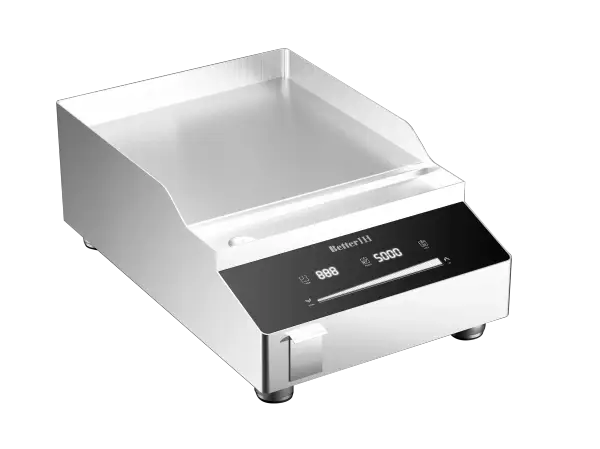
Selecting a reliable heavy duty induction cooker ensures consistent performance under relentless commercial pressure and heavy pots. Pan-detection sensors instantly cut power when cookware is lifted, optimizing energy consumption across the entire kitchen floor.
Digital touch controls must respond accurately even when operators wear heavy kitchen gloves or have wet hands during service. Manufacturers must customize interface placements to match specific line-of-sight preferences requested by executive chefs.
Why Choose Better Induction for a Custom Cooking Island?
Executing a complex commercial kitchen project requires an experienced manufacturing partner capable of delivering tailored engineering and reliable hardware solutions.
Better Induction specializes in custom equipment dimensions, precise electrical specifications, and advanced thermal management configurations. Our engineering team collaborates closely with kitchen consultants to map out clearance metrics and power distribution before factory fabrication begins.
Every heavy duty induction cooker and commercial induction range we build undergoes rigorous quality assurance testing to withstand continuous thermal shock and vibration. Better Induction provides complete technical documentation, installation guides, and wiring diagrams to streamline local regulatory approval and on-site setup.
Our comprehensive OEM and ODM capabilities allow commercial kitchen operators to scale their culinary infrastructure with absolute confidence. Partnering with Better Induction guarantees long-term operational resilience and superior performance across demanding hospitality environments worldwide.
GET IN TOUCH
Contact With us