
While a commercial induction cooktop and an induction stove might sound like entirely separate equipment categories, the difference rarely lies in the underlying heating technology. Both descriptions typically apply to professional units powered by electromagnetic induction. Instead, the more significant distinctions stem from how the equipment is physically built, installed, and utilized within a commercial kitchen environment.
Recognizing this difference saves B2B buyers from a common mistake—specifying equipment by name alone. The real evaluation goes beyond comparing a cooktop to a stove; it is about how each physical design fits into and supports a complete professional cooking station.
Is a Commercial Induction Cooktop Different from an Induction Stove?
The first point to clarify is that “cooktop” and “stove” do not necessarily identify two different induction technologies. They are commonly used to describe the form or configuration of cooking equipment.
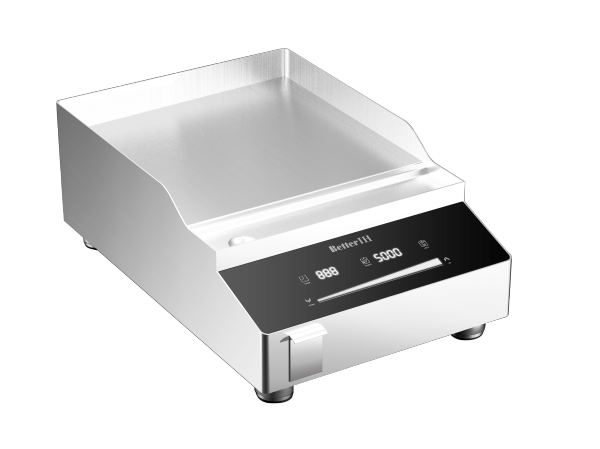
An induction cooktop generally emphasizes the cooking surface itself. It may be designed as a table-top unit, built-in appliance, or drop-in cooking surface. The commercial induction range on our reference page includes all three configuration categories, along with free-standing and heavy-duty formats.
An induction stove, in contrast, usually suggests a more complete cooking station rather than only the cooking surface. Its structure may incorporate the cooking position into a larger, self-contained unit. Therefore, the practical difference is often equipment configuration rather than heating principle.
This distinction matters because a buyer searching for a commercial induction cooker may actually be looking for either a standalone cooking surface or a complete professional cooking station. The terminology alone does not provide enough information to determine which product is required.
How Does a Cooktop Configuration Differ from a Stove Configuration?
Physical integration is one of the clearest ways to distinguish the two. A cooktop can be positioned on a countertop or integrated into a work surface. Built-in and hidden configurations are also listed within our commercial product categories, showing how induction cooking surfaces can be incorporated into a wider kitchen design.
A stove-style unit places greater emphasis on the complete equipment structure. Free-standing equipment, for example, provides its own physical station rather than relying on an existing countertop. That makes the term “stove” more closely associated with a self-contained cooking arrangement.
The difference can therefore be visualized simply: a cooktop is primarily the cooking surface and its integration, while a stove generally represents the cooking unit as a whole.
Commercial projects may also combine several configurations. Our commercial product categories include table-top, free-standing, built-in/hidden, drop-in, and heavy-duty designs. Buyers should therefore examine the actual construction and installation format rather than relying on the product name alone.
Where Does Each Commercial Induction Format Fit?
Where and how you plan to install the equipment dictates its ideal format. Tabletop cooktops offer the flexibility of a standalone, repositionable appliance. In contrast, built-in or drop-in models become a permanent, flush part of your countertop workstation, while free-standing units establish a robust, independent cooking station.
Performance and function further define your choices. For high-demand kitchens, heavy-duty 3500W systems handle rapid boiling and continuous wok station work. For front-of-house or service lines, buffet induction units maintain precise food-holding temperatures, and programmable automatic induction cookers take the guesswork out of batch cooking, simmering, and delicate sauce prep.
The difference between a cooktop and a stove affects how the equipment fits into your kitchen. By considering the layout, format, and application together, you can identify the equipment configuration your kitchen actually requires.
Why Do Commercial Buyers Need to Distinguish the Two?
For a distributor, importer, kitchen integrator, or OEM customer, the terminology affects how a product is specified. A buyer who needs a countertop cooking position should not evaluate the project in the same way as one requiring a complete free-standing cooking station.
Installation is especially important. A built-in or drop-in unit needs to work with the planned counter structure, while a free-standing product must function as an independent equipment station. Selecting the wrong format can create unnecessary modifications even when the induction cooking function itself is suitable.
The distinction also becomes useful when comparing commercial induction cooking equipment from different suppliers. Rather than comparing product names, we recommend checking the actual configuration: table-top, built-in, drop-in, free-standing, or heavy-duty. That approach produces a much clearer technical comparison.
This principle holds true for OEM and ODM projects as well. At Better Induction, we treat equipment configuration as a core product requirement rather than assuming "cooktop" and "stove" imply identical designs. Because our commercial range spans various physical formats, specifications can be directly aligned with the intended installation context.
Which Term and Configuration Should You Choose?
The simplest answer is that a commercial induction cooktop generally refers to the cooking surface or cooking module, while an induction stove more often refers to a larger, self-contained cooking unit. However, these terms are not universal technical classifications, so the product's actual construction should always take priority over its name.
If the project requires a cooking surface integrated into a countertop, built-in or drop-in equipment is the more relevant direction. If the requirement is an independent cooking station, a free-standing configuration may be more appropriate. For demanding professional operations, heavy-duty designs provide another configuration category to evaluate.
In the end, these two terms differ primarily in structure, setup, and overall equipment scope, rather than the core induction technology itself. We advise buyers to first determine their ideal cooking station layout before selecting the matching configuration.
When looking at commercial induction cooking equipment, it is best to evaluate the physical design, operational purpose, and installation requirements all at once. Doing so makes it simple to tell a cooktop apart from a full stove, ensuring you end up with the exact specifications your kitchen needs.
GET IN TOUCH
Contact With us