
The choice between freestanding and built in induction cookers looks purely aesthetic—one sits on top, one tucks below the counter. The actual decision involves installation labor, capital investment, kitchen workflow, and the permanent nature of one option versus the flexibility of the other.
A freestanding unit slides into place and cooks. A built-in unit requires cabinetry, countertop modifications, and structural work before it can operate. Both are legitimate choices; they serve different kitchen scenarios and carry different cost and commitment profiles.
Physical Installation: Countertop Space vs. Integrated Design
Freestanding induction cooktops require only floor space and an electrical outlet. Place them on an existing countertop, plug them in, and cooking begins. No cutting, no framing, no cabinetry modification. This simplicity is why freestanding equipment dominates temporary kitchens, food trucks, catering operations, and rental spaces. The equipment occupies countertop surface area, but installation time is measured in minutes.
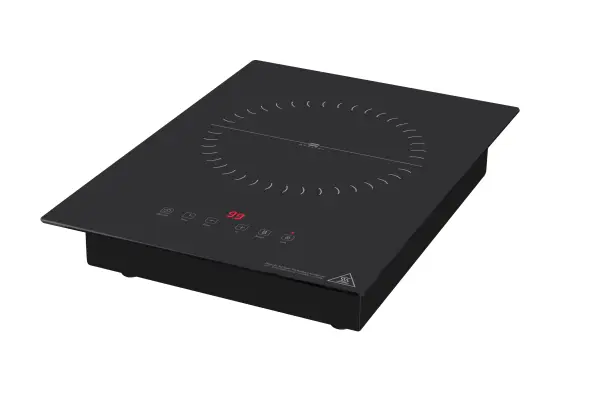
Built-in induction cooktops demand integration into cabinetry. Installers cut openings in countertops, install trim rings or bezels to seal the edge, anchor the cooktop to cabinet supports, and route electrical wiring through cabinet structure. This work takes days, not minutes.
If your kitchen has existing cabinetry, the countertop must be cut to exact specifications; misalignment means wasted material and reinstallation. If you're building new cabinetry, the opening must be designed before construction begins. Better Induction's built-in induction cooktops are engineered for precise fit, but installation still requires skilled carpentry and precise measurement.
The spatial implication is that freestanding equipment uses countertop surface but doesn't consume it permanently. Built-in recesses equipment into the counter, saving surface area but creating a fixed footprint. For kitchens with abundant countertop, freestanding is faster and reversible. For kitchens where countertop real estate is scarce, built-in recovers that space and creates a cleaner visual line.
Budget Scope: Equipment Cost vs. Renovation Investment
Freestanding equipment costs less upfront and that's often where the budget conversation ends—the unit price is what buyers see. Built-in equipment also has a unit price, but the true cost emerges during installation. Cabinetry work, countertop cutting, electrical routing, and trim installation add $800–$3,000+ depending on kitchen complexity. A kitchen with existing cabinetry pays for modification; a kitchen built from scratch with built-in cooktops designed in absorbs the work into initial construction at lower incremental cost.
Total cost of ownership differs by scenario. New kitchen construction planning for built-in induction cooktops from the start pays minimally above base cabinet cost. Retrofitting a freestanding unit into an existing kitchen avoids renovation entirely but consumes countertop workspace. Retrofitting a built-in unit into an existing kitchen pays both equipment and significant renovation costs. Understanding your scenario matters: are you building new, or modifying existing space? That distinction shifts the economics dramatically.
Built-in induction cooktops also lock you into a specific configuration. If you later decide you want a different number of hobs or different layout, moving a built-in unit means new countertop work. Freestanding equipment slides to a new location or swaps out entirely without structural modification. That flexibility has financial value if your cooking needs or kitchen layout change over time.
Kitchen Workflow Under Each Configuration
Freestanding and built-in cooktops create different working relationships between the cook and supporting surfaces. Freestanding equipment sits on top of existing counters, creating a two-level workspace: lower counter for prep, raised cooktop surface for cooking. Chefs work at two heights, stepping between prep and cooking areas. This separation suits some workflows and frustrates others depending on cooking style.
Built-in units integrate the cooktop surface into the counter, creating a unified work plane. Workspace flows seamlessly; ingredients move directly from prep area to cooking surface without height change. Professional kitchens and high-volume cooking operations often prefer this continuity. Home cooks and small operations sometimes find the unified surface cramped—they want dedicated counter space separate from the cooking zone.
Heat management also differs slightly. Freestanding cooktops release heat from the bottom and sides; built-in units release heat primarily from the top surface and through cabinetry ventilation, requiring proper ventilation installed below.
Undersized ventilation under a built-in unit causes heat accumulation that can damage cabinet structure or create uncomfortable kitchen temperatures. Freestanding units are more forgiving—heat dissipates into the room more openly—though this means the kitchen gets warmer overall during heavy cooking.
Better Induction designs both configurations to handle heat safely, but installation quality matters. Built-in units demand proper ventilation planning; freestanding units require only adequate electrical service and space for heat release.
Replacement and Future Modifications
Freestanding equipment ages, fails, or becomes outdated. Replacement is straightforward: unplug the old unit, remove it from the counter, place the new one in its location. If you want to add a second burner or change capacity, you deploy different equipment. Cost is the equipment price alone.
Built-in equipment replacement requires opening the countertop, removing the old unit, sealing the opening if the new unit is smaller, or modifying cabinetry if the new unit is larger.
This permanence has real consequences. If your cooking needs change, a freestanding unit adapts easily. A built-in unit commits you to its configuration unless you're willing to pay for countertop and cabinetry modification again.
Some kitchens benefit from that commitment—it forces intentional design decisions and creates a finished, integrated appearance. Other kitchens regret it when circumstances change.
Equipment failures also play differently. A freestanding cooktop fails, you call service, they replace it while you use a backup. A built-in unit fails, service visits involve more disruption because the unit is anchored into cabinetry.
Repair takes longer; replacement requires more coordination. This isn't a reason to avoid built-in equipment, but it's a real operating cost to understand.
Making the Decision: Scenario-Based Guidance
Choose freestanding if you're renting, operating in temporary kitchen space, or explicitly want flexibility to change equipment without renovation cost. Freestanding equipment also makes sense when countertop modification is not practical. It can also preserve countertop space for prep work instead of integrating the cooktop into the counter.
Choose built-in if you're designing a new kitchen from the start (built-in cost blends into construction), or if unified countertop workspace is essential to your workflow and you're committed to the kitchen configuration long-term. Built-in also serves restaurants and professional kitchens where integrated design and controlled aesthetics matter.
Many kitchens benefit from hybrid approaches. A galley kitchen might use built-in induction cooktops to preserve counter space, while a large kitchen with ample countertop might prefer freestanding equipment for flexibility. Better Induction built-in induction cooktops come in single and multiple hob configurations, matching both minimalist and high-volume needs.
The decision isn't about which is objectively better—it's about which aligns with your kitchen's constraints, your budget structure, and your willingness to commit to permanent design choices. Freestanding prioritizes flexibility and simplicity; built-in prioritizes integration and workflow continuity. Knowing your priorities resolves the choice.
GET IN TOUCH
Contact With us