
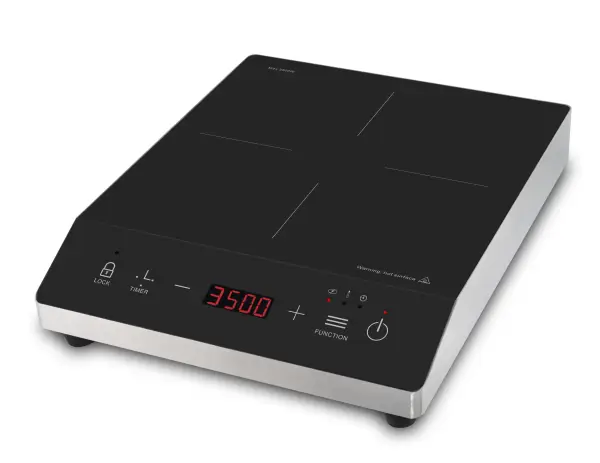
When your kitchen procurement team evaluates new cooking equipment, wattage feels like a straightforward spec—but it's actually the most consequential decision shaping both your menu capability and daily operational constraints. A 3500W induction cooker represents a specific thermal ceiling: fast enough for precision cooking, compact enough for tight footprints, yet requiring honest assessment against your actual menu demands. This guide walks you through the decision frame that separates a smart equipment investment from an underperforming addition to your kitchen.
Why Foodservice Buyers Prioritize Wattage Selection
Power output directly controls how quickly your equipment responds to cooking tasks and how consistently it maintains temperature under load. When a dinner rush hits and you're juggling multiple pans, a cooker underpowered for your menu becomes a bottleneck—not a cost savings. Conversely, oversized equipment wastes electricity and occupies space needed for more versatile stations.
The 3500W category occupies a strategic middle ground. It's powerful enough for techniques demanding rapid heat response (like deglazing or sauce reduction), yet restrained enough to fit countertop footprints and standard 208–240V single-phase circuits that most mid-sized operations already support. Understanding where 3500W excels, and where it struggles, prevents post-purchase regret.
The 3500W Performance Window: What It Actually Powers
3500W induction cookers operate within a thermal envelope designed for sustained performance rather than peak specialization. To contextualize this: searing a steak in cast iron at 180–220°C requires roughly 1500–2500W of sustained input once the pan is preheated. At 3500W, you maintain that temperature comfortably while absorbing the brief thermal drop when cold protein hits the hot surface—a critical difference between consistent color and uneven browning.
For prolonged tasks like bringing a 10-liter stockpot to a boil or maintaining a simmer for sauce reduction, 3500W provides headroom without the energy waste of higher wattage units cycling unnecessarily. The unit heats efficiently across the power spectrum, from 400W for delicate warming to full output for high-demand moments. Better Induction's 3500W Commercial Induction Cooker models include precision control across this range, allowing your kitchen to adapt the same station to multiple cooking methods throughout service.
Cooking Scenarios Where 3500W Delivers Results
Your menu is the ultimate arbiter of wattage fit. Consider what you actually cook:
If your kitchen focuses on sauces, reductions, soups, and braises—the backbone of many hotel room service and catering operations—3500W sustains perfect heat without overshooting temperature sensitivity. Seafood boils, pasta water management, and stock preparation all benefit from this power tier. A 3500W cooker handles large soup pots and stock containers reliably, maintaining rolling boils without thermal instability.
If your menu includes stir-fry or rapid wok work, 3500W becomes marginal. Wok cooking demands "fierce heat" (in traditional gas terms, 20–40kW thermal input)—achieving high wok temperatures (200°C+) in under 20 seconds requires 15kW+. A 3500W unit will heat a wok but slower than integrated high-power stations, potentially slowing ticket times during high-volume service.
Seared proteins, pan-roasted vegetables, and sautéed aromatics operate squarely in the 3500W sweet spot. The cooker delivers fast temperature response for hot-pan techniques while avoiding the power overkill that drives up electricity costs for lighter stations.
Electrical Setup and Installation Realities
Most facilities assuming they can plug any induction cooker into existing circuits discover too late that 3500W commercial equipment requires dedicated 208–240V single-phase circuits, not standard 120V household outlets. This is non-negotiable infrastructure, not a limitation you negotiate around.
A 3500W unit at 240V draws roughly 15A continuous—meaning you need a dedicated 20A circuit breaker (local code typically requires 125% of rated draw for continuous loads). If your proposed kitchen location shares circuits with other equipment, adding induction forces an electrical upgrade that can exceed the equipment cost itself. Before equipment selection, verify your site's available 208–240V supply and spare circuit capacity.
Hardwired vs. plug-in configurations also matter. We at Better Induction offer multiple installation options across our 3500W lineup—some models accept standard NEMA 6-20P plugs, others support hardwired 3-phase configurations for high-density kitchens. Confirm your facility's infrastructure and local code requirements before purchase. Installation mistakes here create safety risks and operational delays that cripple your ROI.
Comparing 3500W Against Alternatives for Your Menu
The choice between 3500W and 5000W hinges on service volume and menu complexity. 5000W units heat faster and recover quicker after high-load cooking, but cost more and demand higher electrical draw (roughly 21A at 240V). If your kitchen projects peak demand at 3–4 simultaneous high-heat stations, 3500W per unit is sufficient when distributed across the line. If you're running a high-volume seared-fish operation with constant demand, 5000W or integrated multi-burner configurations become more realistic.
Lower-tier 1800–2500W portable units are cheaper but unsuitable for sustained commercial service—they cycle off under load and create inconsistent results. At the opposite end, 8kW+ stations target specialized applications (wok cooking, large-scale pasta production) and require 3-phase power most mid-tier kitchens don't have.
3500W bridges this gap: professional-grade output, standard electrical compatibility, rapid payback on energy efficiency vs. gas, and enough power density to support most non-specialized menus.
Sizing Your Kitchen's Induction Strategy
The induction cooker power choice should reflect your kitchen's operational bottlenecks, not industry averages. Start by answering three questions: What dishes drive your busiest service periods? How many simultaneous high-heat stations does your menu require? What electrical infrastructure exists at your proposed equipment location?
We at Better Induction tailor hardware to your exact needs, from single-burner 3500W countertop models to multi-hob integrated lines, ensuring your kitchen dictates the gear—not the other way around.
The best defense against buying the wrong equipment is a transparent look at your actual workload, not just marketing materials. Once your daily workflow is clear, a 3500W unit often emerges as the ideal middle ground: delivering pro-level performance without straining your facility's electrical capacity.
GET IN TOUCH
Contact With us