
High-volume cooking does not always mean the same thing. A restaurant may prepare many dishes from one countertop station, while a central kitchen may need several cooking zones operating simultaneously. Both can describe their operation as “high volume,” but the equipment requirement is very different.
That is why we would be careful about calling a 3500W induction cooker a universal solution for high-volume production. Its 3500W maximum output can be useful for a demanding individual cooking station, but whether it is enough depends on how much cookware, food, and continuous production that station must handle.
What Does “High-Volume” Mean at One Cooking Station?
The first distinction is between high workload at one burner and high workload across an entire kitchen.
A single station may be busy throughout service, with cookware repeatedly placed on the hob and different dishes prepared one after another. In that situation, a 3500W cooker can be a reasonable commercial specification because the station has substantial power available whenever stronger heating is required.
A much larger operation presents another situation. If several pans, pots, or cooking processes need heat simultaneously, one induction zone cannot provide simultaneous heating capacity simply because its individual rating is 3500W.
The Better Induction commercial range reflects this difference in equipment format. The referenced 3500W page includes table-top, free-standing, built-in/hidden, drop-in, and heavy-duty categories, alongside other commercial induction equipment.
For procurement purposes, we would therefore define high volume by the number of cooking tasks a station must handle, how frequently those tasks repeat, and whether several heating zones need to operate at the same time.
3500W Gives One Station a Wider Heating Range
A 3500W rating is most useful when a cooking station needs meaningful heating capacity without moving immediately into a larger multi-zone installation.
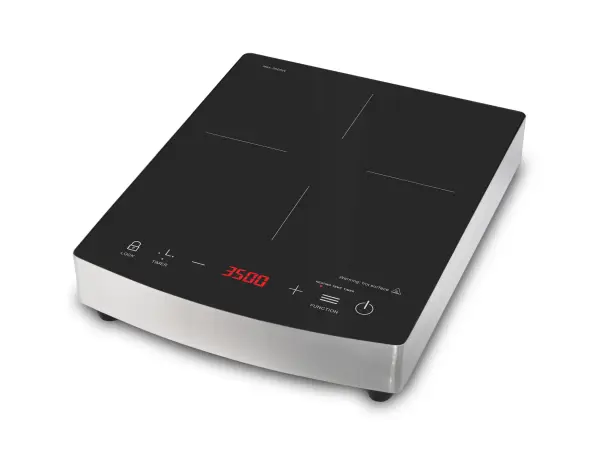
The HBC35, for example, is specified at 3500W, with 1–10 power levels ranging from 350W to 3500W. It also operates across a stated temperature range of 60°C–240°C.
That range matters in a busy kitchen because repeated cooking does not mean every task requires maximum output. A station may need high power for one part of the workflow and substantially less for another.
Having 3500W available gives the operator more capacity at the upper end, while the lower settings prevent the cooker from being limited to high-output cooking. This makes the specification more relevant to a mixed restaurant workflow than a cooker designed around only one narrow heating condition.
The same HBC35 specification lists 350W lower-power continuous heating. For a station that alternates between stronger heating and lower-intensity cooking, that lower operating point is an important part of the equipment's usefulness.
Can It Handle More Than High-Heat Cooking?
High-volume service creates a misleading assumption: if the cooker is used continuously, it must operate continuously at maximum power.
That is not how most cooking stations work. A busy station can move through several stages, with the required heating level changing according to the food and cooking process. A useful commercial unit therefore needs to provide adjustment rather than simply a high maximum rating.
The HBC35 offers 1–10 temperature settings in addition to its power levels, with a 60°C–240°C stated temperature range. Its timer can also be set from 0 to 180 minutes with an LCD display.
Those controls make the 3500W specification more flexible for repeated cooking. The operator can use the upper end when the workload demands it and then move down to a lower setting rather than treating the cooker as a single-purpose high-heat appliance.
Other models in the same commercial range provide comparable specifications. HBE350C, for example, lists 350W–3500W across 10 power levels, 10 temperature settings, a 60°C–240°C temperature range, and a 0–180-minute timer.
For high-volume cooking, this distinction matters: capacity at the top end is useful, but controllable capacity is more useful than maximum wattage alone.
Where a Single 3500W Unit Stops Being Enough
A 3500W cooker should not be presented as a replacement for a complete heavy-duty cooking line.
If the production requirement involves several independent cooking tasks at once, the limiting factor becomes the number of available heating zones rather than the rating of one countertop cooker. A single 3500W unit cannot simultaneously provide 3500W of heating to multiple separate vessels.
Better Induction's own product range illustrates the difference. The EW350C6 is listed as a heavy-duty induction cooker with 3500W × 6 power, rather than one 3500W cooking position.
That configuration is fundamentally different from a single-zone table-top cooker. It is intended for an installation where multiple induction heating positions are required.
Consequently, we would regard a single 3500W unit as potentially suitable for a high-volume individual station, but not automatically sufficient for a kitchen whose production volume requires multiple simultaneous cooking zones.
How We Would Match 3500W to a High-Volume Kitchen
Our starting point is the busiest cooking station, not the average workload.
If one station repeatedly handles demanding cooking tasks but only needs one active cooking position at a time, 3500W can be a sensible commercial power rating. The published HBC35 specification combines the 3500W maximum with lower operating levels, temperature adjustment, a timer, stainless-steel construction, and electronic overheating protection.
If the kitchen needs several pots or pans cooking simultaneously, we would instead examine multi-zone or heavy-duty equipment. The question then changes from “Is 3500W enough?” to “How many independent induction zones does the operation actually require?”
Installation also needs to match the intended workload. A table-top unit may suit a flexible cooking station, while a built-in, drop-in, free-standing, or heavy-duty configuration may make more sense for a fixed production line. The commercial range includes all of these categories.
That is why we at Better Induction view a 3500W induction cooker as the ideal match for a single, high-traffic workstation, rather than treating every heavy-duty kitchen as a blanket 3500W setup. Making this distinction helps operators avoid two common traps: underspecifying a demanding cooking line or overpaying for massive systems when a single powerhouse station will do the job.
For restaurateurs and kitchen managers, it all comes down to multitasking volume. If you have one station that gets slammed repeatedly during service, a 3500W induction cooker is a brilliant fit.
But if your team needs to juggle multiple pans at the exact same time, you're looking at multi-zone units or heavier commercial builds. That is the real dividing line between a standard countertop powerhouse and full-scale kitchen infrastructure.
GET IN TOUCH
Contact With us