
The choice between tabletop and built-in commercial induction cookers is driven by kitchen layout rather than raw power. Different commercial environments—from hotels and restaurants to caterers and distributors—often require unique installation formats for the exact same cooking tasks.
Featuring both tabletop and built-in/hidden formats in our commercial range, we at Better Induction help you match the equipment style to your operational workflow, whether you need portable flexibility or permanent countertop integration.
Tabletop vs. Built-In: What Is the Fundamental Difference?
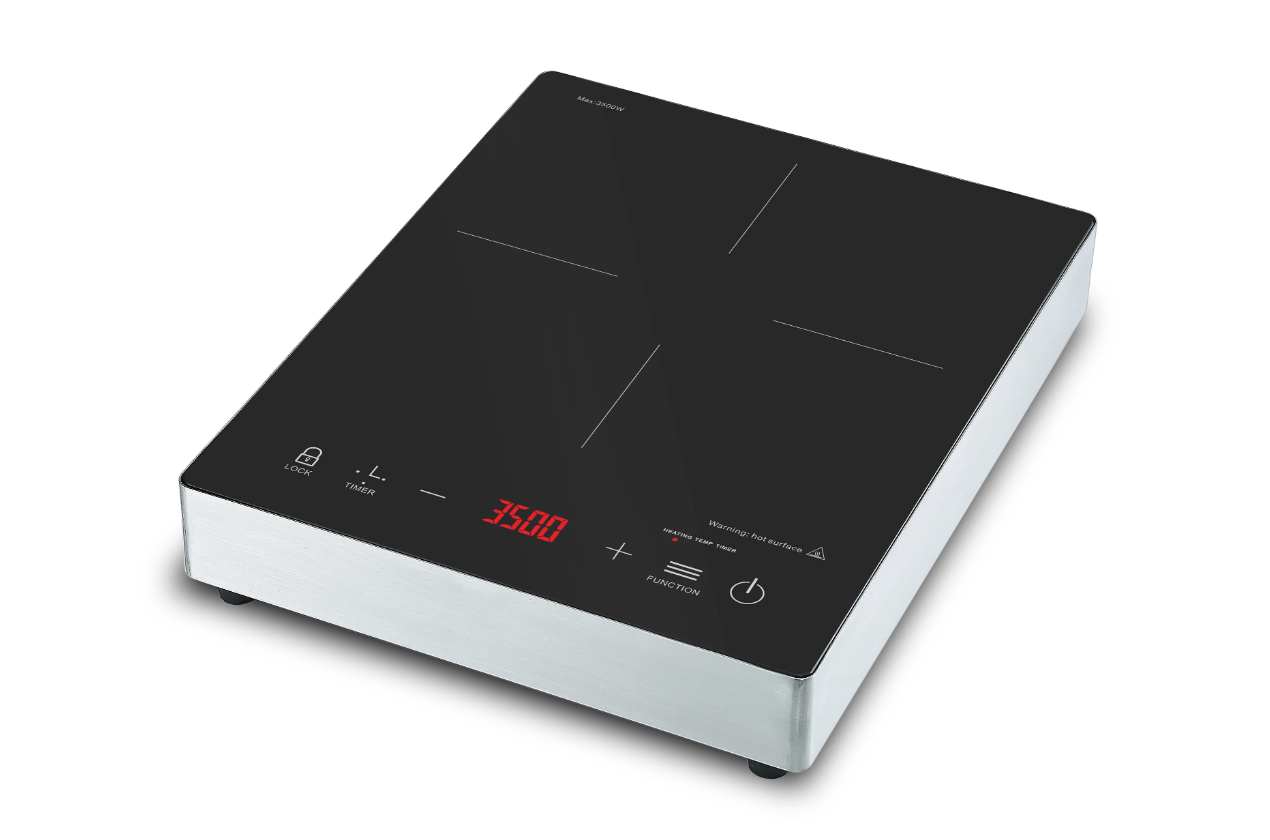
The clearest distinction is installation. A tabletop cooker is designed to sit on a work surface as an independent appliance. Our commercial range identifies table-top as a dedicated category, alongside built-in/hidden, drop-in, free-standing, heavy-duty, and other commercial formats.
A built-in commercial induction cooker is designed for integration into the cooking station. Instead of placing the complete appliance on top of the counter, the installation is planned around the equipment and the surrounding work surface. Models such as our BT-350T and E100B2 are specifically categorized as built-in induction cookers.
That difference changes the purchasing decision. A buyer should first determine whether the cooking station itself is flexible or permanently planned, then evaluate the specific induction model.
When Is a Tabletop Commercial Induction Cooker the Better Choice?
Tabletop equipment is usually the more straightforward option when the cooking station needs to remain independent. A kitchen may need to rearrange equipment, add a cooking position, or deploy the same equipment across different work areas. A separate appliance does not require the countertop to be designed around its dimensions.
Our HBE350C demonstrates the type of specification available in this format. The listed model measures approximately 31 × 43 × 9.3 cm and offers 1–10 power levels from 350–3500 W, a 60°C–240°C temperature range, timer control, and electronic overheating protection.
For distributors and commercial kitchen buyers, this format can also simplify standardized procurement. A tabletop model can be specified as an individual equipment item instead of being treated as part of a complete countertop installation.
That makes tabletop equipment particularly relevant when flexibility and straightforward deployment are more important than integrating the cooker into the furniture.
When Should You Choose a Built-In Commercial Induction Cooker?
Built-in equipment becomes more relevant when the cooking station has already been designed around a fixed position. The cooker becomes part of the overall workstation rather than functioning as a separate appliance placed on top of it.
A built-in commercial induction cooker should therefore be considered together with the counter design, installation dimensions, access requirements, and the intended position of the cooking zone. The equipment specification cannot be separated completely from the physical installation.
Our BT-350T, for example, is categorized as a built-in induction cooker and is listed with dimensions of approximately 36 × 38 × 12 cm, 1–10 power levels from 500–3500 W, and a temperature range of 60°C–240°C. It also uses a stainless steel body, glass hob, knob control, and electronic overheating protection.
A fixed kitchen project may therefore favor built-in equipment when the buyer wants the induction cooking position to be incorporated directly into the planned workstation.
Tabletop vs. Built-In: Which Specifications Should You Compare?
The format alone does not determine cooking capability. Product specifications still need to be compared model by model.
Power range is one of the first points to check. Our tabletop HBE350C is listed at up to 3500 W, while the built-in BT-350T is also listed with power levels reaching 3500 W. This shows why buyers should not assume that built-in equipment is automatically weaker or that tabletop equipment is automatically more powerful.
Temperature and control settings should then be matched to the cooking task. Both example models provide ten power levels, while the listed temperature ranges are also clearly specified. Other models can differ, so the exact product should always be reviewed before procurement.rrespond with the planned workstation. For tabletop procurement, dimensions still matter, but the installation relationship is less dependent on the counter itself.
Which Format Fits Your Commercial Kitchen Project?
The simplest decision rule is to start with the installation requirement, then verify the product specification.
Go with a tabletop design if your unit needs to stay portable and easy to rearrange, or if your kitchen layout is subject to change. Select a built-in model when building a permanent workstation where the induction unit needs to blend flush into the countertop design.
Our commercial range is intentionally divided into multiple formats rather than treating every professional kitchen as identical. The commercial induction cooking equipment portfolio includes tabletop, built-in/hidden, drop-in, free-standing, heavy-duty, and specialized induction solutions.
This mindset extends to all OEM and ODM collaborations. At Better Induction, equipment configuration is a core part of the product spec—not an afterthought. Because our commercial range includes a variety of physical formats, we can easily link your specifications to the right installation environment.
At Better Induction, we therefore recommend making the format decision before narrowing down individual models. Once the installation type is clear, buyers can compare power, dimensions, controls, temperature settings, and protection features against the actual cooking requirement.
The answer is not that one format is universally better. Tabletop is the stronger choice when flexibility is the priority; built-in is the stronger choice when countertop integration is the priority. Selecting the format according to the kitchen's physical design first creates a much more reliable basis for choosing the final commercial induction cooker and commercial induction cooking equipment configuration.
GET IN TOUCH
Contact With us