
Professional kitchens place demands on cooking equipment that household users rarely encounter. A cooker may operate through long service periods, handle different cookware sizes, and move repeatedly between high heat and controlled cooking. For that reason, choosing a suitable commercial induction cooker requires more than checking its advertised power rating.
We evaluate professional equipment according to how well it performs the actual work required in a kitchen. Heating consistency, output, controls, construction, and configuration all contribute to whether an induction cooker can function reliably as part of a commercial cooking station.
Consistent Heating Is the First Requirement
Professional cooking depends on predictable heat. A chef may need to bring a large vessel to temperature, maintain a simmer, or switch rapidly between cooking stages. If heating behavior is inconsistent, operators have to compensate manually, which can affect workflow and cooking results.
For us, a good commercial induction cooker therefore begins with dependable heating performance. The equipment should be selected according to the type of vessels, cooking volumes, and processes it will handle rather than judged only by a short test with a small pan.
Induction equipment is particularly useful where direct control over the cooking process is required. The commercial range from Better Induction includes different equipment configurations intended for professional cooking environments, allowing the equipment format to be matched with the operational requirement.
Power Output Must Fit Professional Cooking Tasks
Power is important, but the correct output depends on what the kitchen actually cooks. A station preparing sauces does not necessarily require the same configuration as a wok station handling high-intensity cooking or a kitchen boiling large quantities of food.
Our commercial equipment range includes 3500W models and higher-power configurations for demanding cooking requirements. The product range specifically includes equipment for applications such as wok cooking, boiling, and other high-volume food preparation. Buyers should therefore consider the required cooking process before choosing a power level.
A commercial induction cooker also has to be compatible with the site's electrical infrastructure. Available voltage, electrical capacity, installation conditions, and the number of units operating simultaneously should be reviewed before equipment is specified.
The objective is not to purchase the highest available wattage. Instead, the output should provide sufficient capacity for the intended vessel size and cooking workload while fitting the kitchen's electrical setup.
Precise Controls Matter During Busy Service
Professional operators rarely use one heat level for an entire cooking cycle. They may need intense heating at the beginning, followed by controlled cooking or simmering. Easy and predictable adjustment becomes particularly valuable when several orders are being prepared simultaneously.
Control functions can also influence repeatability. Our automatic induction equipment is designed around programmable control for applications such as batch cooking, simmering, and sauce preparation. That type of functionality can be relevant when a kitchen needs operators to follow repeatable cooking procedures.
Better Induction approaches control design according to the intended application rather than treating every commercial unit as identical. A simple countertop station may need straightforward manual operation, while a specialized cooking process may benefit from more automated control.
Heavy-Duty Construction Supports Daily Kitchen Use
A professional cooker must physically withstand its working environment. Commercial kitchens involve frequent cookware movement, repeated heating cycles, routine cleaning, and continuous interaction between operators and equipment.
Our heavy-duty commercial induction cooking equipment incorporates reinforced coils, impact-resistant surfaces, and thermal-management features for demanding commercial use. These characteristics are relevant because the equipment needs to manage both cooking activity and the physical conditions around a busy workstation.
The cooking surface also deserves attention. Its material and design should suit the intended kitchen environment and cleaning routine. Buyers should examine construction details together with the equipment's intended application rather than assuming that every induction unit is built for the same level of commercial use.
The Cooker Format Must Match the Workstation
Equipment configuration is another defining characteristic of a good commercial induction cooker. Professional kitchens use induction in different locations, so a single physical format cannot suit every installation.
A tabletop unit can be appropriate where equipment needs to sit directly on a work surface. Built-in and drop-in configurations can be integrated into a designated cooking counter, while free-standing equipment can form part of a larger cooking line. Specialized formats such as induction wok equipment address cooking methods that require a different vessel and workstation arrangement.
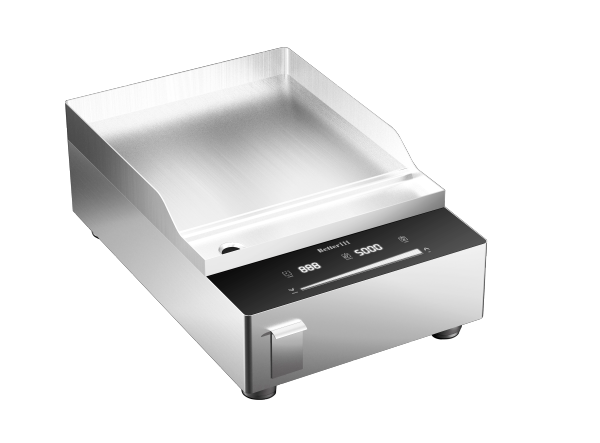
Our commercial portfolio includes tabletop, built-in, drop-in, free-standing, wok, fryer, griddle, and warming configurations. This range reflects a practical point: equipment should be selected around the cooking station and task.
A Good Commercial Cooker Must Work as a Complete Kitchen Solution
The strongest choice is not necessarily the cooker with the longest specification sheet. Professional suitability comes from the relationship between heating output, controls, construction, physical configuration, cookware, and the kitchen's electrical conditions.
A commercial induction cooker should therefore be evaluated against the exact workload it will perform. A buyer should establish the cooking tasks first, determine the required output and control method, then select the equipment format that fits the workstation.
At Better Induction, we believe commercial cooking equipment should adapt to your kitchen, not the other way around. That’s why we offer customizable configurations designed for specific professional workflows.
We apply this same mindset to OEM/ODM collaborations—building equipment specs around your target audience, workspace conditions, and installation needs to deliver precisely what the market demands.Performance is what truly sets a commercial cooker apart.
Rather than chasing a single standout number, true quality comes from the optimal balance of power, control, durability, and design.
GET IN TOUCH
Contact With us