
A heavy-duty induction cooker is not simply a commercial induction unit with a higher power rating. For restaurant buyers, the more useful question is whether the equipment is designed for the workload, installation format, and cooking environment of a demanding professional kitchen.
We look at heavy-duty induction equipment from that perspective. A commercial induction range becomes relevant when a cooking station has sustained production requirements, while a heavy duty induction cooker is better understood as part of a broader professional equipment category that includes countertop, drop-in, free-standing, and cooking-island configurations.
The difference becomes obvious during a long service
A cooker can appear perfectly adequate during a short cooking test and behave very differently during continuous restaurant service. Lunch and dinner operations may require the same station to remain productive through repeated cooking cycles rather than occasional use.
That is where heavy-duty equipment starts to make sense. Better Induction's heavy-duty range includes countertop models such as EK600P-2 and EK600W-2, drop-in models such as BI500P-800 and BI500P-400, and free-standing equipment including E800C and EW500S1-H.
The range is therefore organized around professional cooking environments rather than a single appliance format. A buyer equipping a high-use production station should first ask how continuously the equipment will operate and where it needs to be installed.
For a kitchen that only needs occasional supplemental cooking, heavy-duty equipment may be unnecessary. A station that remains active throughout service presents a much stronger case.
A 5000W station tells you this is more than a countertop replacement
Power is one useful indicator, but it should not be used alone to define heavy-duty equipment. The specifications of Better Induction's heavy-duty models show why.
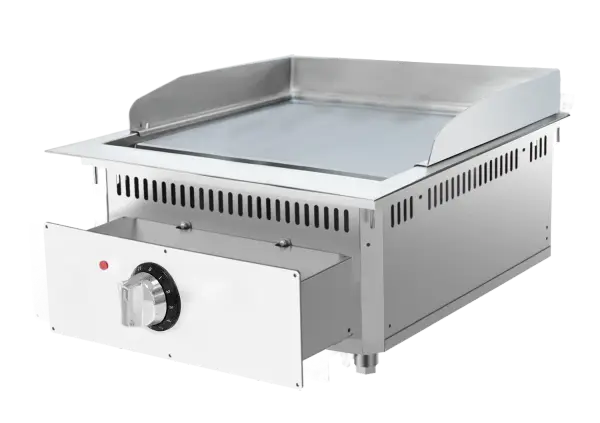
BI500P-800 is specified at 5000W, with a 380–420V 3N~ 50–60Hz electrical configuration and a temperature range of 80°C–300°C. It is a drop-in induction cooker with a stainless-steel body and knob control.
EK600P-2 is also specified at 5000W, but it is a table-top model measuring approximately 40 × 60 × 23.3 cm. Its listed temperature range is 60°C–280°C, and it uses touch control with a stainless-steel body.
These two examples demonstrate an important purchasing point: even within the same 5000W class, the installation method and operating interface can be different.
The buyer should therefore avoid treating wattage as the entire definition of heavy-duty equipment. The physical configuration and intended kitchen environment matter just as much.
A built-in cooking line calls for a different answer
Imagine a hotel or restaurant designing a permanent cooking line rather than adding a portable appliance to an existing counter. The equipment becomes part of the kitchen architecture.
That is where drop-in heavy-duty induction models can become particularly relevant. Better Induction lists BI500P-800, BI500P-400, BI500PS, BI500F, and BI500W under its Heavy Duty Drop-In category.
A drop-in format can be evaluated as part of the workstation design, while a countertop model is generally considered around the existing work surface. The two formats may serve similar cooking functions but solve different installation problems.
A commercial induction range therefore makes sense only after the buyer has identified the station format. Choosing the power first and trying to fit the equipment into the kitchen afterward can create unnecessary design constraints.
High-volume kitchens are not the only ones that may need heavy duty
A common assumption is that only large restaurants need heavy-duty induction equipment. In practice, the more useful criterion is workload intensity.
A compact catering operation may have fewer cooking stations but still place substantial demands on each one. A hotel banquet kitchen may experience concentrated periods of production. A central kitchen may require equipment to support repeated cooking tasks throughout the working day.
Those environments can have a stronger reason to consider heavy-duty equipment than a much larger restaurant with relatively light cooking requirements.
Better Induction organizes its heavy-duty solutions into countertop, drop-in, free-standing, and professional cooking-island categories. That range gives buyers a way to match the equipment format to the workflow instead of assuming that “heavy duty” means one particular physical design.
Your electrical specification has to support the workload
The electrical requirement becomes especially important as power capacity increases. Buyers should not treat a 5000W specification as interchangeable with the electrical setup used for a smaller commercial appliance.
BI500P-800 and EK600P-2 are both specified at 380–420V 3N~ 50–60Hz and 5000W. This means the installation needs to be assessed against the actual electrical environment before the equipment is selected.
That check is particularly important for international projects and commercial kitchen renovations. The buyer should confirm the destination electrical standard, available supply, and exact model configuration with the equipment supplier.
A heavy duty induction cooker only becomes a practical choice when the kitchen can support both its physical installation and electrical requirements.
Who should put heavy-duty induction on the shortlist?
The strongest candidates are kitchens where cooking stations face sustained professional workloads and where the equipment needs to become a permanent or purpose-designed part of the operation.
That can include hotels, high-volume restaurants, catering operations, central kitchens, banquet facilities, and other foodservice environments where repeated production puts greater demands on cooking equipment.
We at Better Induction offer multiple heavy-duty configurations precisely because these kitchens do not all work in the same way. A countertop station may need EK600P-2, while a built-in cooking line may call for a drop-in configuration such as BI500P-800.
The final decision should therefore come from the station's workload, installation format, power requirement, and cooking workflow.
A heavy-duty unit is not automatically the right choice simply because it has a higher output. For a low-use station, a lighter commercial model may be more appropriate. For a demanding production station, however, selecting equipment designed around professional workloads can make far more sense than stretching a lighter appliance beyond its intended role.
That is the practical meaning of heavy duty: not merely more watts, but equipment selected for the demands of the kitchen it has to serve every day.
GET IN TOUCH
Contact With us