
Investing in professional induction cooking equipment requires looking beyond raw power numbers. Every restaurant kitchen operates differently—featuring unique workloads, cooking styles, spatial layouts, and peak-hour routines—meaning a one-size-fits-all approach rarely works.
We guide commercial induction cooker selection by focusing first on your real-world kitchen environment. By matching power, precision control, build quality, installation type, and cooking functions to your actual service workflow, we give restaurant operators a clear path to the ideal induction solution.
What Kind of Induction Equipment Does the Restaurant Actually Need?
The first decision should come from the cooking station itself. A restaurant should identify whether the equipment will be used for boiling, frying, simmering, wok cooking, warming, batch preparation, or another specific task. The expected workload also matters because occasional preparation creates different requirements from continuous commercial cooking.
Our commercial equipment range reflects these differences through several configurations, including table-top, free-standing, built-in, drop-in, automatic cooking, wok, fryer, warmer, buffet, and cooking-island equipment.
Consequently, restaurants should avoid selecting a general-purpose appliance before defining the station's job. A dedicated wok unit, for example, should be evaluated differently from equipment intended for buffet warming or programmable cooking.
How Much Power Does the Kitchen Really Need?
Power is another question that should be answered according to the cooking task. Higher output can be useful for demanding cooking operations, but maximum wattage alone does not determine whether an appliance is suitable. Restaurants should also consider how precisely staff need to adjust the cooking level during service.
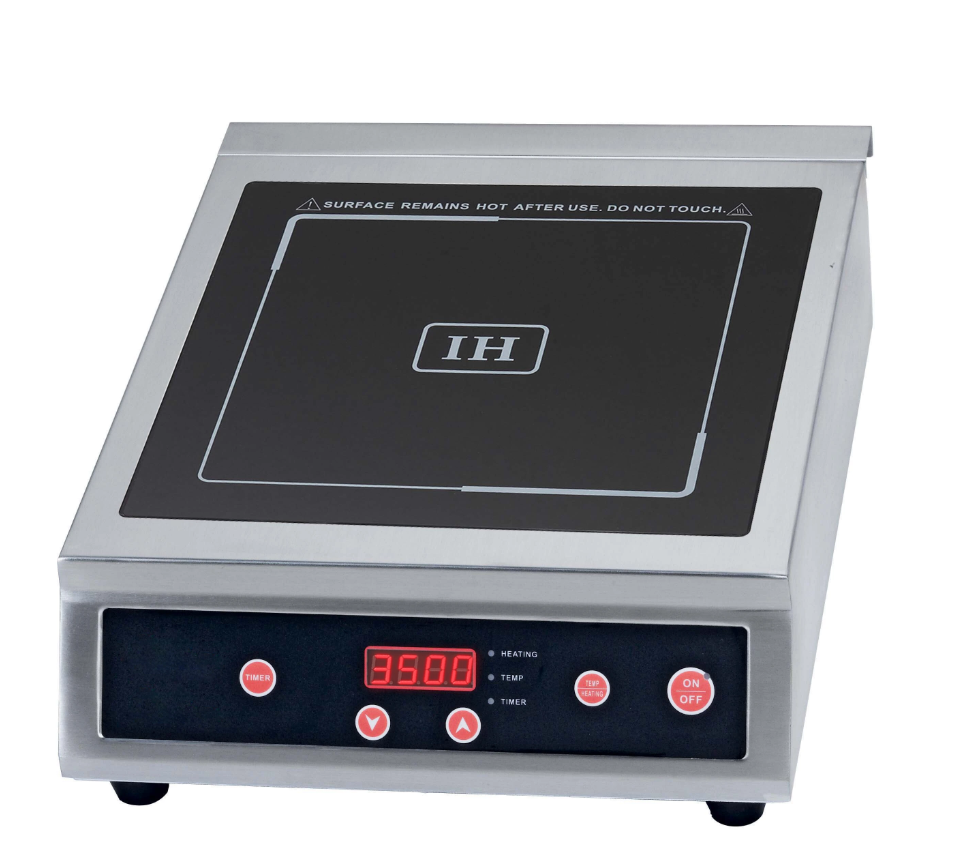
The BT-350B-A provides ten power levels from 500W to 3500W and ten temperature settings from 60°C to 240°C. Its timer range is specified as zero to 180 minutes.
Such specifications give buyers a better way to judge whether the available control range corresponds with their cooking requirements. Electrical conditions should also be checked at this stage. A listed free-standing model, for example, is specified at 5000W × 2 with a 380–420V three-phase supply.
Will the Controls Work Naturally During Restaurant Service?
Cooking equipment has to be practical for the people operating it. Restaurant staff may need to change heat levels quickly, maintain a particular temperature, or use timed cooking functions without interrupting the workflow.
Restaurants should therefore compare the control system with the actual station. A straightforward manual interface may be appropriate for frequent heat adjustments, while programmable time-temperature control can be useful for repeatable cooking tasks. The question is not which interface looks most advanced, but whether staff can operate it efficiently during service.
Can the Equipment Handle the Conditions of a Working Kitchen?
Restaurant equipment faces considerably more demanding conditions than equipment used occasionally at home. Buyers should therefore examine the actual construction and protection specifications instead of relying on a generic “commercial” label.
The BT-350B-A is specified with a stainless-steel body and offers glass, Schott Ceran, or EuroKera France hob options. Electronic overheating protection is also included in its listed specifications.
Other commercial equipment in the range is described with features such as reinforced coils, impact-resistant surfaces, and thermal management for heavy-duty use. These details give restaurant buyers specific characteristics to compare when assessing equipment for demanding stations.
Where Will the Equipment Go in the Kitchen?
The physical location of the appliance can determine which configuration makes sense. A restaurant should consider whether the unit will sit on an existing worktop, become part of a fixed counter, operate as a dedicated cooking station, or be integrated into a larger cooking island.
Our commercial induction equipment is available in table-top, free-standing, built-in/hidden, and drop-in formats. Each format addresses a different installation requirement, so the kitchen layout should be established before the final model is selected.
This is particularly relevant for restaurant projects involving customized counters or cooking islands. Equipment dimensions, installation requirements, electrical connections, and access for operation should be considered together rather than treated as separate purchasing details.
Does the Equipment Match the Restaurant's Cooking Method?
A final selection should make sense for the food being prepared. Restaurants using several cooking methods may need different induction configurations rather than installing identical appliances at every station.
Commercial induction cooking equipment can cover specialized functions as well as general cooking. The available categories include grand induction wok equipment, induction fryers, induction warmers, buffet stations, and automatic cooking equipment.
This specialization can make the equipment specification more closely reflect the menu and workflow. A wok station, for instance, has different requirements from a food-holding station, while automated cooking may be considered where repeatable time and temperature settings are useful.
Ultimately, restaurants should judge a professional commercial induction cooker by how closely its specifications fit the intended station. The right decision connects the cooking task with suitable power, controllability, construction, installation format, and equipment configuration.
Better Induction recognizes that no two restaurant kitchens are alike, providing customized commercial induction solutions instead of a generic approach. This flexibility is essential when planning complex layouts with multiple cooking zones and diverse equipment styles.
To make the right choice, restaurant operators should prioritize function over raw power. Rather than asking which cooker has the highest output, focus on whether a given model meets your specific cooking demands, integrates smoothly into your workspace, and keeps pace with peak service. That is how you select induction equipment that genuinely delivers in a professional kitchen.
GET IN TOUCH
Contact With us