
Restaurant equipment rarely becomes inadequate overnight. More often, the kitchen changes first. Orders increase, menus expand, cooking stations become busier, or a renovation changes how equipment needs to be installed. Eventually, a cooker that once seemed sufficient begins to hold back the operation.
That is the point at which a restaurant should start evaluating a heavy duty induction cooker. We do not think the decision should be based on age alone or on the appeal of higher wattage. The better approach is to identify where the existing cooking station is struggling and determine whether a heavier-duty solution addresses that specific problem.
The First Warning Usually Appears During Peak Service
A cooking appliance can seem perfectly adequate for most of the day and still be undersized for the restaurant's busiest period. The real test often comes when several orders arrive together and the same station has to maintain production without interruption.
Repeated delays are worth paying attention to. If cooks regularly have to wait for a pan, move tasks to another station, or reduce the number of items being prepared simultaneously, the equipment may no longer match the workload.
Peak service also exposes whether the available heat range is sufficient for the way the kitchen actually cooks. Heavy-duty equipment is designed for professional applications where cooking stations can face more demanding workloads.
Better Induction's heavy-duty range includes dedicated countertop, drop-in, free-standing, and cooking-island configurations, giving commercial kitchens different ways to address high-use cooking stations.
A restaurant does not necessarily need to upgrade because service is occasionally busy. The stronger signal is a recurring pattern: the same station becomes a bottleneck whenever normal peak production begins.
When One Station Starts Carrying Too Much of the Menu
Menu growth can quietly change the workload of existing equipment. A cooker originally assigned to a few dishes may eventually support preparation, cooking, reheating, and service for a much larger portion of the menu.
That kind of expansion can make an old specification unsuitable even if the appliance itself is still functioning normally. The problem is not mechanical failure. It is a mismatch between what the station was designed to handle and what the restaurant now expects it to do.
A useful review starts by listing the tasks assigned to the station. How many dishes depend on it? How often is cookware changed? Does the same unit handle both high-output cooking and lower-temperature work? Are several cooks depending on it during the same service period?
A commercial induction range can become a better fit when the cooking station needs greater capacity and more deliberate integration into the restaurant's production workflow. The upgrade should follow the workload rather than simply replace one appliance with a larger version.
Better Induction's heavy-duty category includes multiple models and configurations, allowing buyers to compare equipment according to the actual station rather than treating every restaurant as having the same cooking requirements.
A Bigger Kitchen May Require a Different Equipment Format
Restaurant expansion can change the equipment decision completely. Adding more seats or increasing production may lead to a redesigned kitchen, and a redesigned kitchen may no longer need the same type of induction appliance.
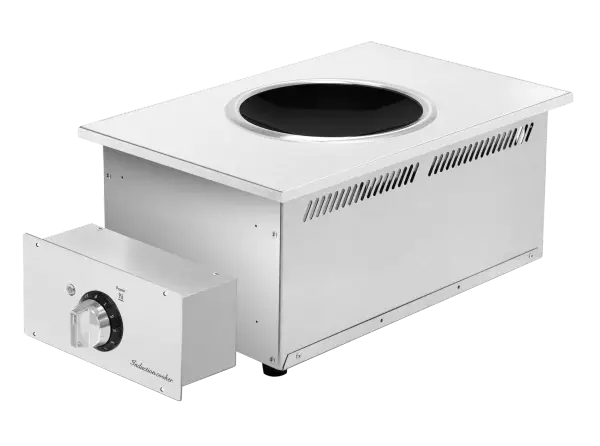
A countertop cooker can be useful when flexibility and straightforward placement are priorities. But once induction becomes part of a permanent cooking line, a drop-in format may make more sense because the equipment can be incorporated into the workstation itself.
Better Induction lists heavy-duty drop-in models including BI500P-800, BI500P-400, BI500PS, BI500F, and BI500W. Its heavy-duty range also includes countertop and free-standing configurations.
This matters during upgrades because the question may no longer be “What should replace our old cooker?” Instead, it may be “What should this cooking station look like now?”
For example, a restaurant renovating its main cookline may have an opportunity to move from portable equipment toward integrated equipment. A catering operation expanding its production capacity may prefer a different arrangement altogether.
The physical format should therefore be reconsidered whenever the kitchen layout is changing. An upgrade is a good opportunity to correct an installation limitation that has been tolerated simply because the old equipment was already in place.
Power Capacity Can Turn an Upgrade Into a Kitchen Project
Moving to heavier-duty induction equipment can also introduce a larger electrical requirement. That means the purchasing conversation needs to include the building's available power, not just the cooking team's preferred equipment.
Some Better Induction heavy-duty models are specified at 5000W and use a 380–420V 3N~ 50–60Hz electrical configuration. EK600P-2 and BI500P-800 are examples listed with these specifications.
A restaurant should confirm these requirements before finalizing an upgrade. The existing electrical installation may have been designed around lower-powered equipment, particularly in an older kitchen.
New construction and major renovations provide more flexibility because electrical planning can happen alongside the kitchen design. Replacement projects are more complicated when the restaurant needs to work within an existing supply.
International projects require another layer of verification. Voltage, frequency, connection configuration, and destination-market requirements should be confirmed against the exact model being ordered.
For this reason, upgrading to a commercial induction range can sometimes become a broader kitchen project. That is not necessarily a disadvantage, but buyers should know about the infrastructure implications before committing to a higher-capacity unit.
Upgrade When the Current Cooker Becomes the Constraint
The strongest reason to upgrade is not that the existing cooker has reached a certain age. It is that the appliance has stopped matching the demands placed on its cooking station.
Repeated peak-service delays are one signal. A growing menu is another. Kitchen expansion, a redesigned cookline, or a change from countertop equipment to integrated installation can also justify a fresh evaluation.
The same applies when cooks need a broader operating range or when the existing equipment cannot comfortably support the production volume expected from the station. In each case, the restaurant has a specific operational reason to reconsider its equipment.
A heavy duty induction cooker should then be evaluated against the new requirement. Better Induction's heavy-duty equipment covers countertop, drop-in, free-standing, and cooking-island formats, so the upgrade can be matched to the revised kitchen configuration rather than limited to a like-for-like replacement.
We would recommend documenting the station's busiest workload before selecting a model. Record which cooking tasks create delays, how frequently the station operates at high demand, what installation format is required, and what electrical capacity is available.
That information gives the buyer a much stronger basis for deciding whether an upgrade is justified. It also prevents a common mistake: purchasing a more powerful appliance without addressing the actual reason the station is underperforming.
Better Induction's heavy-duty range gives restaurants several equipment directions to consider, but the appropriate choice still depends on the kitchen's individual requirements.
Ultimately, the right time to upgrade is when the existing cooker becomes a recurring constraint on production. If the station consistently keeps pace with demand, replacement may not be necessary. Once workload, menu requirements, kitchen layout, or electrical planning have moved beyond what the current equipment can reasonably support, heavy-duty induction becomes a practical upgrade rather than simply a larger purchase.
That is the distinction we would use when evaluating an equipment upgrade: replace the cooker because the kitchen has outgrown its role, not simply because a more powerful cooker exists.
GET IN TOUCH
Contact With us