
Cookware can appear balanced when empty but rock once a cook presses against its rim. One possible cause is a convex base, which curves downward at the center instead of resting evenly across the glass. This difference in shape changes where the cookware receives support and how it responds to sideways force.
This matters in kitchens where pans are moved, stirred, and loaded repeatedly. When selecting commercial induction equipment, buyers should examine the cookware base as carefully as its magnetic compatibility. Pans that heat successfully may still be difficult to handle safely.
Why Does the Pan Rock?
Flat glass can support a flat pan across a broad area. With a convex base, contact becomes concentrated near the center. Pressure applied away from that point can make one edge drop while the opposite edge rises. The result is rocking rather than a firm resting position.
The amount of movement varies with the depth of curvature, pan diameter, and location of the load. Wider cookware may show greater movement at its rim because the rim sits farther from the central support area. Curvature alone, however, does not predict how far the pan will tilt.
The problem may be difficult to notice when the pan is empty. Ingredients gathered on one side, a heavy handle, or a firm stirring motion can expose instability during ordinary use. Cooking tests should therefore reflect actual handling rather than relying only on a quick visual check.
How Does Stirring Change the Balance?
Stirring applies pressure at different points in the pan. Pushing food against the sidewall creates a turning force around the contact area. When support is concentrated near the center, the cookware may tilt toward the applied force instead of remaining steady.
Handle movement creates another source of leverage. Pulling or pressing a long handle can shift the pan even when the cook does not intend to lift it. The effect becomes more concerning when the contents are hot, liquid, or unevenly distributed.
Sudden rocking can splash sauces or cooking oil and interrupt precise movements. Operators may compensate by holding the handle more firmly, but this does not correct the base shape. Replacing unsuitable cookware is more dependable than developing habits around its instability.
Is Heating Performance Affected Too?
Induction transfers energy through a magnetic field into compatible cookware. The base does not need to touch the glass for heating to occur. Still, the distance between the pan and the induction coil can influence magnetic coupling, depending on the appliance and cookware design.
Convex curvature can leave parts of the base farther above the cooking surface. This may change how energy is transferred, although visible rocking does not establish a particular heating loss. Heating performance needs to be checked using the intended pan and appliance together.
For a professional induction cooktop, heating response and physical stability should be treated as separate checks. Smooth power adjustment cannot prevent an unstable pan from tipping. Likewise, magnetic compatibility does not confirm that the cookware will remain steady during stirring.
What Does a Useful Stability Test Include?
Start with a clean, cool pan and a level cooktop that is switched off. Set the cookware down without forcing it flat. Press gently near several points around the rim and note whether the opposite side lifts from the surface.
Rotate the pan and repeat the same movements. If the rocking pattern follows the cookware, its base may be responsible. If movement changes mainly with the position on the glass, inspect the supporting surface as well before drawing conclusions.
Follow with a controlled cooking trial using representative food loads and normal utensils. Observe whether stirring, turning ingredients, or moving the handle causes unwanted tilting. Do not deliberately rock cookware containing hot liquids or oil. Remove noticeably unstable pans from service.
Which Equipment Details Deserve Attention?
Kitchen buyers should compare base diameter, cookware weight, magnetic properties, and expected cooking tasks. Wide sauté pans used for vigorous stirring face different handling forces from small pots used mainly for simmering. Procurement checks should reflect those differences. Buyers should also confirm the manufacturer's cookware recommendations before approving a purchase.
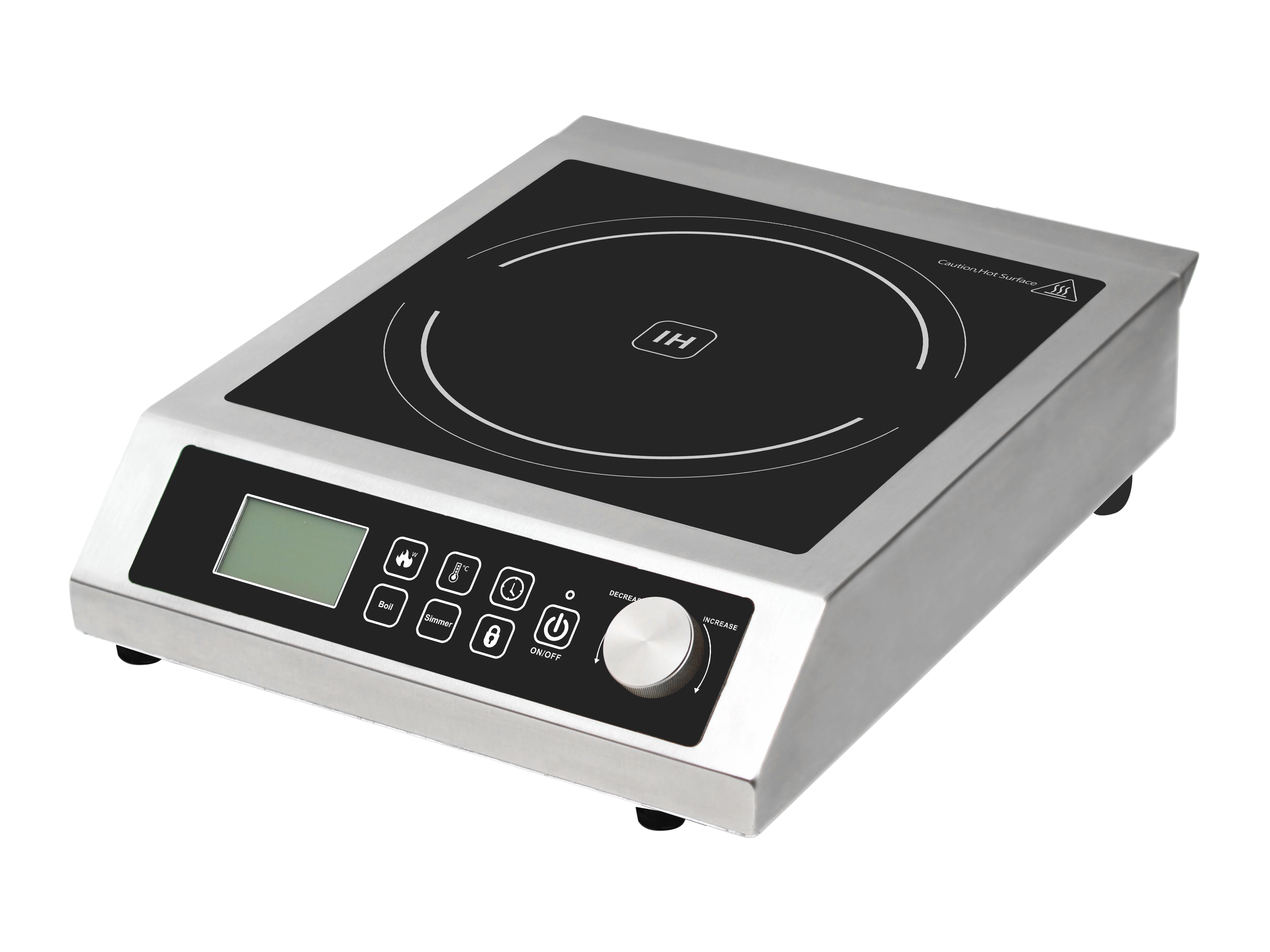
Equipment controls are relevant to the wider cooking workflow, but they cannot straighten a curved base. For example, the HB350K5 features a stainless steel body and half-bridge technology. Hob options include glass, Schott Ceran glass, and Eurokera France glass.
The model also features touch control with a safety lock, an LCD display, knob adjustment for power or temperature, and electronic overheating protection. These functions concern equipment operation. They cannot correct unstable cookware or replace a physical stability test.
In ODM projects, Better Induction discusses application needs during design and manufacturing planning. For buyers of commercial induction equipment, this means describing the cookware types and cooking movements expected in service, rather than specifying the appliance alone.
What Keeps Cooking Operations Steady?
Convex cookware changes how force travels through the pan to the flat glass surface. Centralized support can produce rocking during stirring, handle movement, or uneven loading. The same shape may also affect coil-to-pan spacing, but heating effects require separate verification.
We recommend checking cookware stability before routine use and repeating the inspection when the base shows signs of deformation. At Better Induction, we encourage customers to include representative cookware in trials for a professional induction cooktop. The practical goal is straightforward: cookware that heats as required and stays steady during normal cooking.
GET IN TOUCH
Contact With us